
Your Batchmate Just Got Placed at an MNC. The Secret? SAP Training and Placement
Summary
SAP is one of the most in-demand ERP platforms globally, with over 400,000 companies using it across industries. In 2026, SAP professionals, especially those skilled in SAP S/4HANA, command strong salaries and enjoy wide job opportunities. Quality SAP training and placement programs can help freshers and career switchers break into this field within months.
Imagine applying for a job, and the recruiter says, “Do you know SAP?”
You nod politely. But inside, you’re Googling it under the table.
Sound familiar? You’re not alone. SAP keeps showing up in job descriptions from finance to logistics, from retail to manufacturing and yet most students have no clue what it actually is, whether it’s worth learning, or how to even get started.
This guide is for you. Whether you’re a fresh graduate, a working professional looking to upskill, or someone completely switching careers, let’s break SAP down in plain English and figure out if it belongs in your future.
Table of Contents
- Is SAP a Good Career Choice in 2026?
- Understanding SAP ERP: What Are You Actually Learning?
- How to Learn SAP Online: Choosing the Right Path
- SAP Classes Online: What a Quality Programme Must Include
- What Makes a Reliable SAP Training Institute?
- Conclusion: Is SAP the Right Move for You?
- Frequently Asked Questions
Is SAP a Good Career Choice in 2026?
Short answer: Yes, and here’s why that matters for you.
SAP (Systems, Applications, and Products) is the world’s leading ERP (Enterprise Resource Planning) software. According to SAP’s own data, over 400,000 businesses in more than 180 countries run on SAP, including companies like Nestlé, Siemens, Apple, and Tata. That means SAP professionals are needed everywhere.
Here’s what makes SAP a genuinely smart career move in 2026:
- High demand, low supply. The global SAP talent gap is real. As companies migrate from legacy SAP systems to SAP S/4HANA (a massive industry shift happening right now), they desperately need trained professionals.
- Strong salary potential. Entry-level SAP consultants in India typically earn ₹4–7 LPA, while experienced professionals can command ₹15–25 LPA or more. Globally, SAP roles routinely pay $80,000–$120,000+ per year.
- Industry-agnostic. SAP is used in healthcare, manufacturing, BFSI, retail, IT, energy, and the list is endless. You’re not locked into one sector.
- Future-proof technology. SAP is investing heavily in AI, cloud, and automation through its Business Technology Platform. Learning SAP today means staying relevant tomorrow.
If you’re asking, “Is SAP a good career?” the more important question is: which module is right for you? More on that shortly.
Understanding SAP ERP: What Are You Actually Learning?
Before you enrol anywhere, it helps to understand what SAP ERP actually is because “SAP” isn’t one single thing. Think of it like a massive digital operating system for businesses.
Large companies have dozens of departments: accounts, HR, inventory, sales, and procurement. Traditionally, each team used different software, and the data never talked to each other. SAP ERP solves that by bringing everything onto one integrated platform. When a sales order is placed, SAP automatically updates inventory, finance, and logistics all at once.
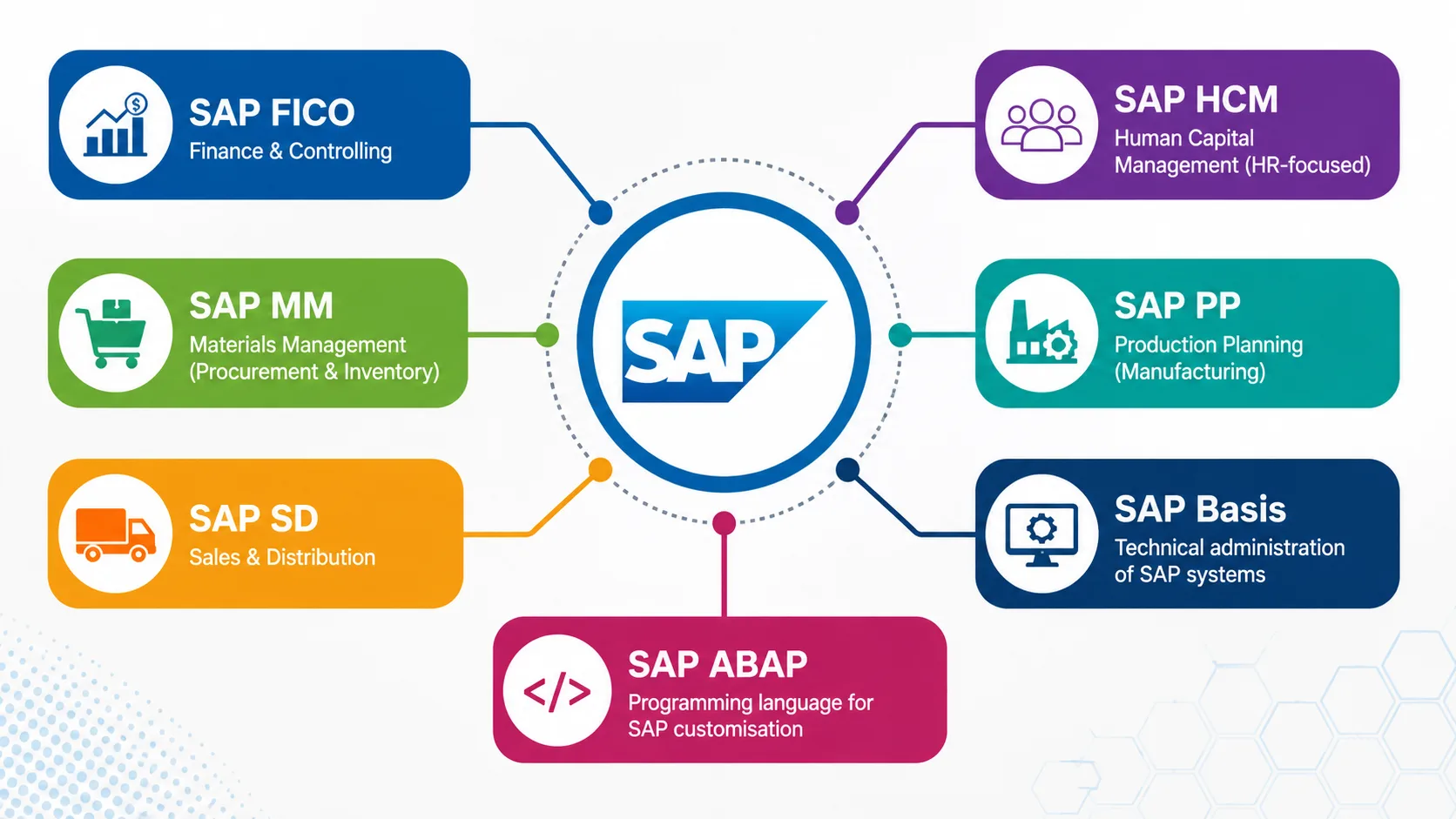
Common SAP modules include:
- SAP FICO: Finance and Controlling (most popular among commerce graduates)
- SAP MM: Materials Management (procurement and inventory)
- SAP SD: Sales and Distribution
- SAP HCM: Human Capital Management (HR-focused)
- SAP PP: Production Planning (manufacturing)
- SAP Basis: Technical administration of SAP systems
- SAP ABAP: Programming language for SAP customisation
Each module requires a different background and leads to different roles. Choosing the right one based on your education and interests is the first real decision you’ll make on this journey.
How to Learn SAP Online: Choosing the Right Path
Here’s the good news: you don’t need to be an IT wizard to learn SAP. Many of the most successful SAP consultants come from commerce, science, or even arts backgrounds.
There are three main ways people learn SAP today:
- Self-study (YouTube + SAP documentation): Technically possible. Practically frustrating. SAP is a complex system, and learning it without guided practice and live system access is like trying to learn to drive from a textbook.
- University or college programmes: Some MBA programmes include ERP or SAP exposure. But these are expensive, slow, and often don’t go deep enough for job-readiness.
- Specialised SAP training institutes (online or offline): This is the most practical route for most learners. The right programme gives you structured learning, hands-on practice on a live SAP system, industry-relevant projects, and crucially, placement support.
When you learn SAP online through a credible institute, you get flexibility without sacrificing quality. You can study from Kolkata, Kochi, or Kanpur, and still access the same SAP system as someone sitting in a classroom.

SAP Classes Online: What a Quality Programme Must Include
Not all SAP courses are created equal. Some hand you a PDF and call it training. Here’s what to actually look for before you pay a single rupee:
- Live SAP system access: Theory without practice is useless in SAP. You must be able to log in to a real SAP environment and execute transactions. If a course doesn’t offer this, walk away.
- Module-specific curriculum: The course should go deep into your chosen module, not just scratch the surface of ten different ones. A good FICO course, for example, should cover General Ledger, Accounts Payable, Accounts Receivable, Asset Accounting, and Controlling in detail.
- Experienced faculty: Trainers should have real industry experience, not just theoretical knowledge. Ask about their consulting background before you enrol.
- Updated content (S/4HANA focused): If a programme is still teaching only ECC 6.0 and ignoring S/4HANA, it’s outdated. The market has moved. Your training should reflect that.
- Doubt-clearing and mentorship support: SAP has a steep learning curve. You’ll have questions. Good programmes build in live doubt sessions, not just recorded lectures.
- Recognised certification preparation: The course should prepare you for SAP’s official associate certifications, which carry significant weight with employers.
- Placement assistance: A strong training institute will have a placement cell, recruiter relationships, and interview preparation built into the programme, not just a vague promise of job support.
Rule the Market with Professional SAP Training |
|||
| SAP Certification Courses | |||
| Explore All SAP Courses SAP FICO Course online | SAP MM Course Online | SAP PP Course Online | SAP SD Course Online |
|||
What Makes a Reliable SAP Training Institute?
Choosing the wrong institute is one of the most costly mistakes a learner can make, and not just financially. You lose months, confidence, and opportunity.
Here’s how to evaluate any SAP training institute before committing:
Check their track record. How long have they been running SAP programmes? Do they have verifiable placement records, real company names, and real roles?
Evaluate the demo class. Most good institutes offer a free demo session. Attend it. Pay attention to how the trainer explains concepts, how the interface looks, and whether you get access to hands-on exercises.
Look for industry connections. Institutes with hiring partnerships with IT companies, consulting firms, and shared service centres will naturally place students better than those without.
Transparency in curriculum and fees. Avoid institutes that are vague about what’s covered or push you to pay before explaining the full programme.
Platforms like ICA Online, which specialise in career-focused IT and ERP courses, are worth exploring if you’re looking for structured SAP training that combines strong content with practical placement support.
Watch the video below and get the complete roadmap!
Conclusion: Is SAP the Right Move for You?
If you want a career that’s globally relevant, well-compensated, and stable enough to grow in for decades, SAP is one of the most solid bets you can make right now. The demand is real. The gap between available jobs and qualified professionals is real. And the opportunity for both freshers and experienced professionals is very much alive in 2026.
The key is starting with the right foundation. Choose your module based on your background. Find a training programme that gives you live system access, experienced mentors, and genuine placement support. And then commit to it seriously.
Your SAP journey starts with one good decision. Make it a well-informed one.
Few related topics for your knowledge
- SAP FICO Vs SAP HANA: Which Is Better
- Analyzing The Procure To Pay Process: A Comprehensive Overview
- How SAP FICO Works In Manufacturing Industry
- SAP FICO Transaction Codes: List Of T-Codes To Remember
- Why Smart Finance Pros Are Rushing To Learn SAP FICO
- 50+ SAP MM Interview Questions and Answers Revealed
Frequently Asked Questions
1. Is SAP a good career for freshers with no IT background?
Absolutely. SAP functional modules like FICO, MM, and SD are well-suited for commerce, science, or business graduates. Domain knowledge is often more valuable than IT skills. Many freshers land their first SAP job within 3–6 months of completing structured training and certification.
2. How long does it take to learn SAP and get placed?
Most learners complete module-specific SAP training in 2–4 months. Add 1–2 months for certification prep and placement preparation. Realistically, plan for 4–6 months from starting training to landing your first role, depending on the module and your consistency.
3. What is the salary of an SAP fresher in India?
SAP freshers in India typically earn between ₹3.5–7 LPA, depending on the module, city, and company. FICO and SD consultants tend to start at the higher end. With 2–3 years of experience, salaries commonly rise to ₹10–18 LPA.
4. Which SAP module is best for a commerce graduate?
SAP FICO (Finance and Controlling) is the most popular and recommended module for commerce graduates. It aligns directly with accounting and finance knowledge, making concepts easier to grasp. SAP MM is also a strong option for those with supply chain or procurement exposure.
5. Is SAP certification necessary to get a job?
SAP certification is not mandatory, but it significantly improves your chances. Many employers view it as proof of verified skills, especially for freshers without work experience. It also increases your credibility during interviews and can positively impact your starting salary offer.
- Data Science Course with Placement: Is It Worth It or Just Marketing? - October 9, 2026
- What is ITC in GST: The Complete Guide You Need - September 26, 2026
- SAP PP Cycle Explained: The Guide Every Fresher Should Read Before Choosing SAP - September 18, 2026