Stuck in a Low-Paying Job? Here is How an ITR Filing Course Can Boost Your Career
Summary
An ITR filing course is a specialised training program that teaches individuals how to prepare and electronically file Income Tax Returns (ITR) in compliance with the Income Tax Act. Pursuing structured income tax filing classes equips you with high-demand practical skills, enabling you to work as a certified tax consultant, accountant, or freelance tax practitioner with excellent income potential.
Here’s something most people don’t realise: over 9 crore Indians filed their income tax returns in FY 2025–26, and every single one of them either figured it out themselves, paid someone to do it for them, or got it wrong.
While tech-savvy individuals try to manage it themselves, a recent study reveals that over 45% of working professionals still prefer hiring a consultant or face immense confusion regarding complex tax deductions, exemptions, and the error-free execution of the e-filing system (Madhura, 2026; Puthur, 2016).
If you are a commerce student, a fresher looking for a breakthrough, or a professional stuck in a low-paying job, this seasonal panic is actually your biggest career opportunity. By mastering tax laws through a professional itr filing course, you can transform yourself from a confused job seeker into a highly indispensable financial asset.
Table of Contents
What is an ITR Filing Course and Why is it Important?
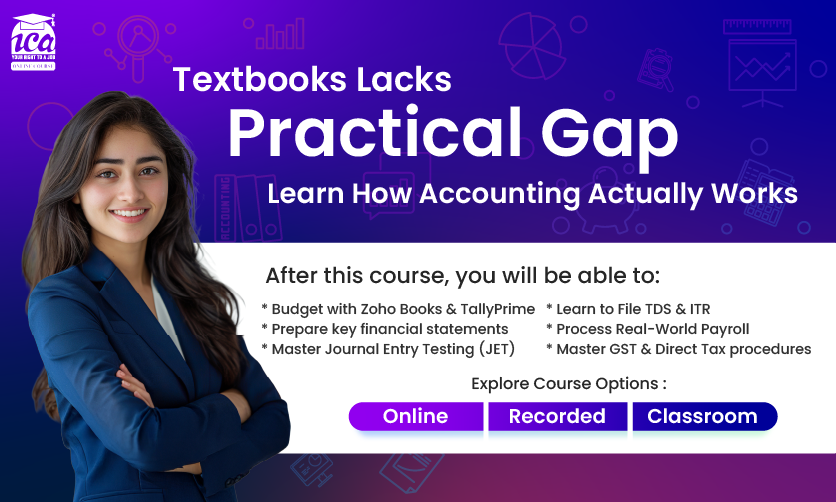
An Income Tax Return (ITR) filing course is a practical training framework designed to bridge the gap between textbook taxation theories and real-world implementation. While university degrees teach you the theoretical provisions of the Income Tax Act, they rarely open the live government portal to show you how data is actually uploaded, processed, and verified.
A comprehensive tax program covers:
- Direct Tax Fundamentals: Comprehensive legal understanding of the five heads of income (Salary, House Property, Business/Profession, Capital Gains, and Other Sources) (Narayan Zantye College, 2022).
- Deduction Maximisation: Practical mastery over sections 80C through 80U to legitimately minimise tax liabilities for clients (Madhura, 2026).
- Portal Navigation: Step-by-step processing of real-time online registrations, form selections (ITR-1 to ITR-4), and handling digital signatures (Puthur, 2016).
Why Is ITR Filing Such a Big Deal Right Now?
Think about this: India had just 6.48 crore ITR filers in FY 2019–20. By FY 2024–25, that number had grown to over 9 crore, a 40% jump in five years.
That’s not just more forms to fill. It’s millions of salaried employees, freelancers, gig workers, small business owners, and first-time earners who need professional help navigating a system that, despite digitalisation, remains confusing for most people.
And here’s the thing: the government is only going to push harder for compliance. With the Income Tax portal’s pre-filled returns, updated return windows, and stricter TDS scrutiny, taxpayers are under more pressure to get it right. That’s a permanent tailwind for anyone with expertise in ITR filing.
Why Should You Join Income Tax Filing Classes?
The financial landscape in India is rapidly changing. The corporate world does not pay for what you know; it pays for what you can execute. Here is why specialised tax training gives you an unfair advantage:
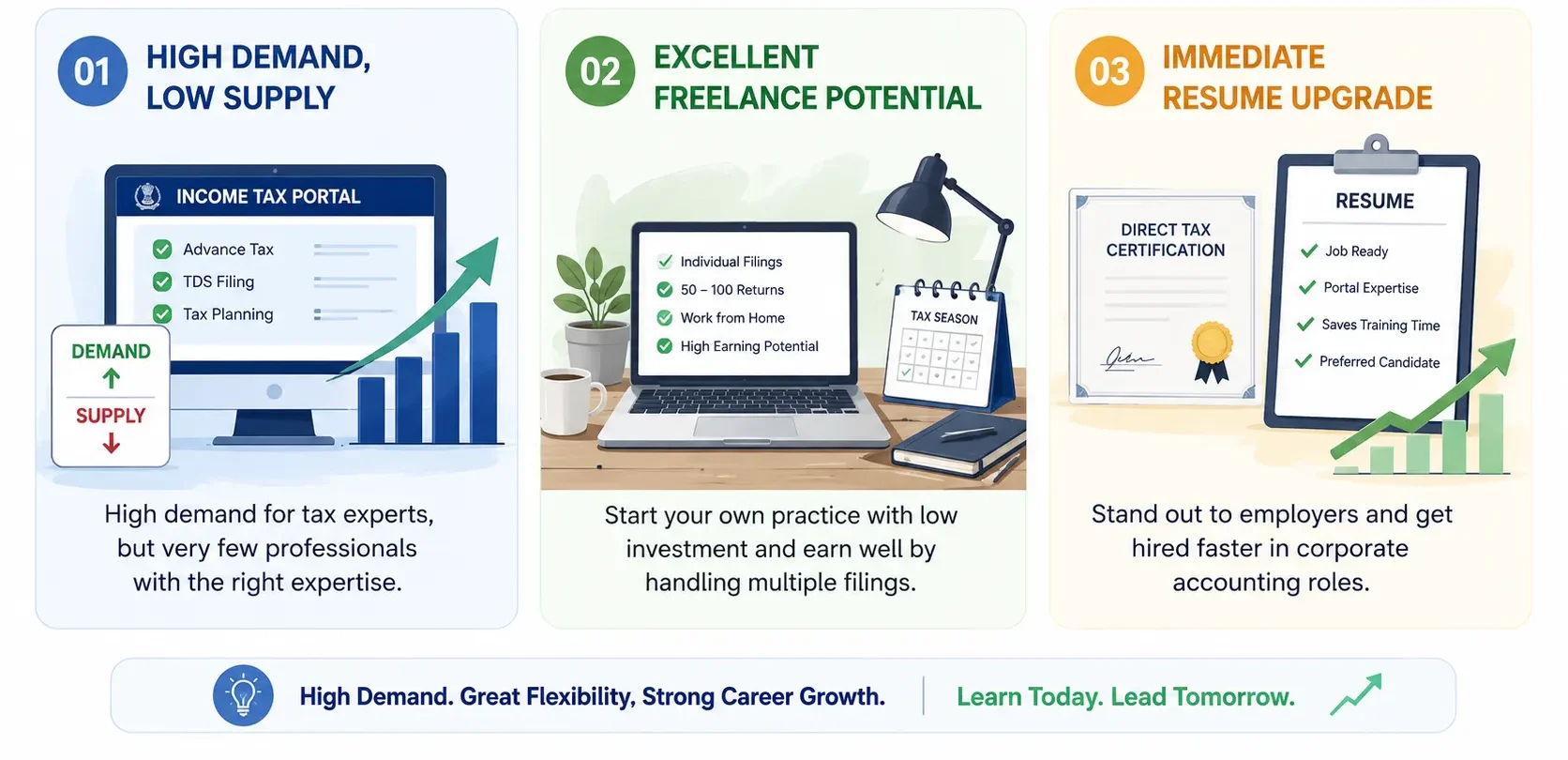
1. High Demand, Low Supply
Every earner above the basic exemption threshold must file their returns. Businesses need tax experts all 12 months of the year for advance tax computations, TDS filing, and tax planning (Thuronyi, 1996). Yet, there is a severe shortage of certified practitioners who know how to navigate the portal seamlessly without causing errors (Puthur, 2016).
2. Excellent Freelance Potential
Taxation is one of the few fields where you don’t need a massive office or heavy funding to start your own business. With the right training, you can easily handle 50 to 100 individual filings every season from the comfort of your home, charging a handsome fee per return.
3. Immediate Resume Upgrade
If you are applying for corporate accounting positions, a certificate in a direct tax course online signals to employers that you are job-ready from day one. It eliminates the need for companies to spend months training you on basic portal logistics.
Can You Learn ITR Filing Online for Free?
Technically, yes. Here’s where free resources exist:
- Income Tax Department’s portal (incometax.gov.in) has step-by-step guides and FAQs
- YouTube has solid practical walkthroughs for each ITR form type
- ICAI publishes some knowledge resources publicly
But free resources come with real limitations; they’re fragmented, often lag behind Budget changes, and don’t give you the structured, accessible learning that employers and clients look for. More importantly, they don’t give you a certification.
A certificate from a recognised programme, one that’s NSDC-aligned or backed by an established institution, carries genuine weight when you’re applying for jobs or pitching services to clients.
If you’re serious about building a career in taxation and not just filing your own return once a year, a structured programme is the right investment. ICA Online’s Direct Tax course is built for exactly this, covering the full direct tax curriculum with ITR filing as a hands-on, practical component, not an afterthought.
Your Tax Career Starts With One Smart Move
Learn ITR filing, deductions, and e-filing compliance with hands-on practical training.
What Jobs Can You Get After an ITR Filing Course?
This is the question most students care about most, and the answer is genuinely promising.
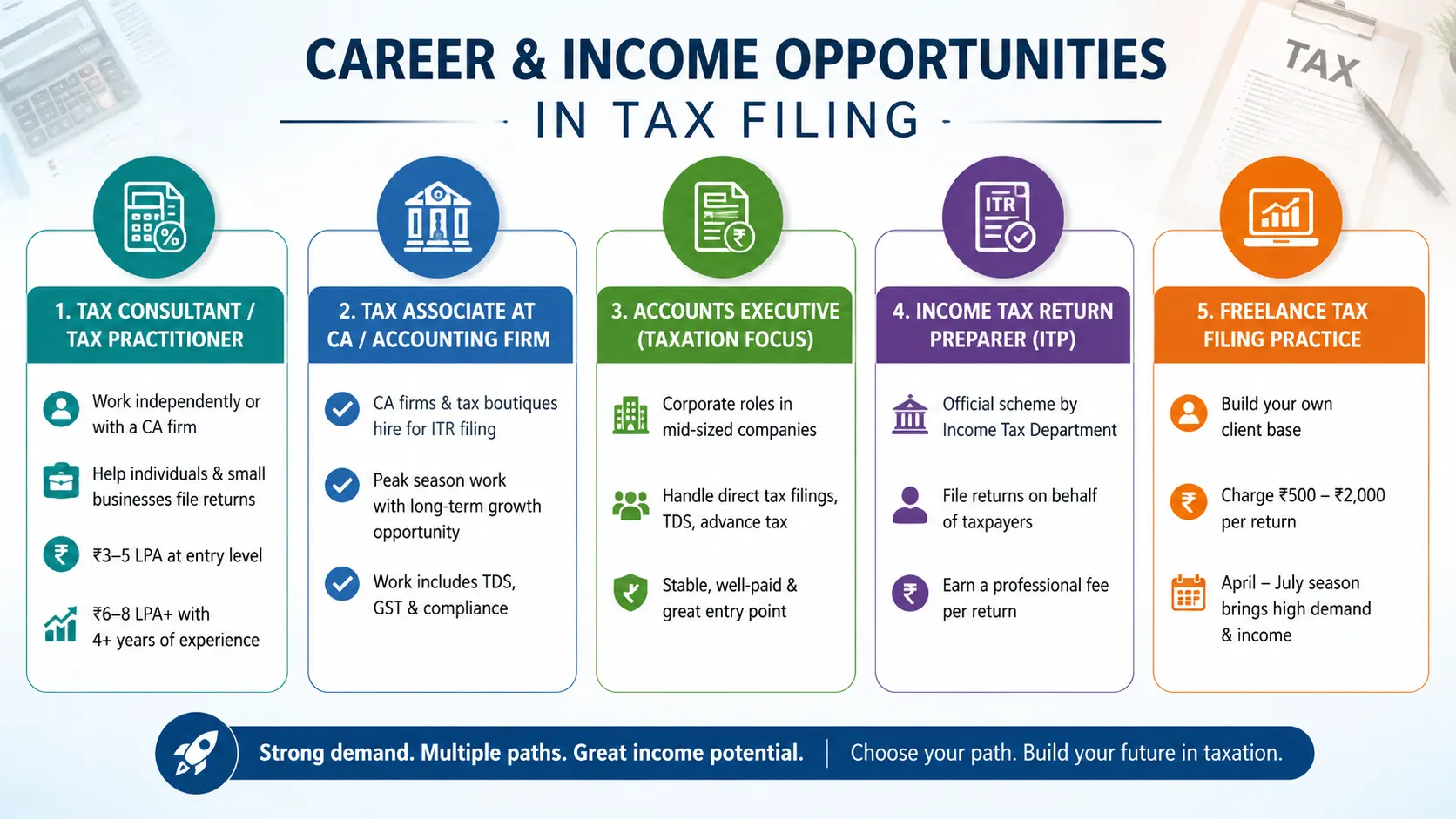
Here are the most common career paths:
- Tax Consultant / Tax Practitioner: Work independently or with a CA firm, helping individuals and small businesses file their returns. Entry-level consultants typically earn ₹3–5 LPA; with 4+ years of experience, earnings jump to ₹6–8 LPA and beyond.
- Tax Associate at a CA / Accounting Firm: Many smaller CA firms and tax boutiques hire trained graduates specifically for ITR filing work during peak season and retain good performers year-round for TDS, GST, and compliance work.
- Accounts Executive (Taxation Focus): Corporate accounts departments in mid-sized companies often need people who can handle direct tax filings, employee TDS, and advance tax tracking. These roles are stable, well-paid, and a great entry point.
- Income Tax Return Preparer (ITP): The Income Tax Department itself has an official Income Tax Return Preparer Scheme that allows trained individuals to file returns on behalf of taxpayers for a fee.
- Freelance Tax Filing Practice: Many certified tax professionals build a client base on the side, charging ₹500–₹2,000 per return. During filing season (April–July), even a modest client list of 100 people generates meaningful income.
According to data from Glassdoor (June 2025), the average salary for a tax consultant in India is around ₹6.7 LPA, with top earners going well above ₹10 LPA. Entry-level positions start around ₹4–5 LPA.
The Ultimate Verdict
Taxation is not just a seasonal chore; it is a booming industry with perennial career growth. Relying solely on a basic college degree will leave you competing with thousands of others for entry-level data entry jobs. On the flip side, spending time to learn direct tax compliance sets you apart as a skilled professional. Take the first step toward future-proofing your financial career today by picking a learning track that provides practical, real-world execution.
Few insightful articles for your knowledge:
- Income From House Property: A Guide To The Tax Payer
- Top 30 Journal Entries Questions And Answers
- Can Science Students Become An Accountant?
- All You Need To Know About Audit Trail In Zoho Books
- What Is General Ledger Accounting And How Does It Work?
- Guide To AI In Accounting: Trends, Tools, And Stats
Frequently Asked Questions
1. Who is eligible to enrol in an ITR filing course?
Anyone with a basic understanding of numbers can enrol. While a background in commerce, business, or accounting (B.Com, M.Com, BBA) offers a slight conceptual advantage, students from other streams, freshers, and working professionals looking to transition into financial consulting can easily master the course through structured training.
2. Can I practice as a tax consultant after completing a direct tax course online?
Yes. Completing a professional course equips you with the practical skills needed to compute total taxable income, claim valid deductions, and file error-free returns. You can confidently start your independent freelance consulting practice, serving salaried individuals and small local businesses.
3. What is the average salary after completing a professional tax course?
A fresher starting as a certified tax executive or accountant can expect a starting salary ranging from ₹2.5 Lakhs to ₹4.5 Lakhs per annum. With experience or by scaling a freelance tax advisory practice, your earning potential increases significantly, especially during peak tax filing seasons.
4. Are free online tax filing courses worth it for professional growth?
Free courses are excellent for gaining a basic conceptual overview or understanding simple individual filings. However, they lack the step-by-step practical training on complex business returns, case studies, regular amendment updates, industry-recognised certifications, and the placement support needed for professional corporate growth.
5. What are the primary documents required to file an individual ITR?
The primary documents include the taxpayer’s PAN Card, Aadhaar Card, Form 16 (for salaried individuals), Form 26AS/AIS (Annual Information Statement) to track tax deducted at source (TDS), bank account statements, and relevant investment proofs to claim deductions under sections like 80C or 80D.

- Interview Training Course: Why Skilled Candidates Still Get Rejected - September 11, 2026
- Accounting Certificate Online: Is It Actually Worth It in 2026? - September 5, 2026
- SAP MM Module T-Codes: The Complete List Every Beginner Actually Needs - August 28, 2026