SAP PP Cycle Explained: The Guide Every Fresher Should Read Before Choosing SAP
Summary
The SAP PP cycle is the sequence of steps SAP’s Production Planning module follows to turn a sales forecast into a finished, warehouse-ready product, starting with demand planning, moving through MRP and capacity checks, and ending with goods receipt and cost settlement. Understanding this cycle is the first real step toward becoming a SAP PP consultant.
Somebody in your circle has probably said, “just learn SAP, it pays well,” and then failed to explain what SAP actually does all day.
If you’re a B.Com, BBA, or engineering graduate trying to figure out your next move, or a working professional whose role has quietly stopped growing, that vague advice isn’t helping you. What actually helps is understanding one real, in-demand skill well enough to explain it in an interview.
The SAP PP cycle is a good place to start. It’s specific, it’s used by almost every manufacturing company running SAP, and unlike a lot of “trending” skills, it maps directly to a job title: SAP PP Functional Consultant.
Let’s break down exactly what it is, how it works, and whether it’s worth your time.
What Is the SAP PP Cycle?
SAP PP stands for Production Planning, one of the core modules inside SAP’s ERP system. The “PP cycle” refers to the full journey a product takes in SAP, from when a company forecasts demand to when it’s manufactured, checked into stock, and its production cost is closed out.
Think of it as the digital backbone of a factory’s “what to make, how much to make, and when” decisions.
The SAP PP cycle includes:
- Demand Management – recording what needs to be produced
- Material Requirements Planning (MRP) – checking if raw materials are available
- Capacity Planning – checking if the factory has the machine and labor hours to deliver
- Production Order Creation & Release – converting a plan into a live work order
- Material Staging / Goods Issue – releasing raw materials to the shop floor
- Execution & Confirmation – recording that production actually happened
- Goods Receipt – moving finished goods into the warehouse
- Settlement – closing out and analyzing the cost of that production run
Every manufacturing company from a bicycle factory to a pharma plant runs some version of this cycle. SAP PP just standardizes and automates it.
Skill Up, Stand Out: Professional SAP Training |
|||
Why Does the SAP PP Cycle Matter for Your Career?
Here’s the part nobody explains clearly: you don’t need to be a mechanical engineer to work in SAP PP.
SAP PP is a functional consulting role. That means you’re configuring how the system handles production processes, not writing code, and not standing on a factory floor. Companies need people who understand both:
- How a factory actually works (materials, machines, timelines)
- How to translate that into SAP’s system logic
That combination is genuinely hard to find, which is exactly why SAP PP consultants stay in demand across manufacturing, automotive, pharma, FMCG, and process industries.
Breaking Down the SAP PP Cycle, Step by Step
Let’s walk through it the way it actually happens on a live SAP system.
- Demand Management: The cycle starts with a forecast, either a sales plan or actual customer orders entered into SAP as a “Planned Independent Requirement.” This tells the system what’s expected to sell.
- Material Requirements Planning (MRP): SAP checks the Bill of Materials (BOM, basically the “recipe” for the product) against current stock. If raw materials are short, it automatically triggers purchase requisitions or planned orders.
- Capacity Planning: MRP alone doesn’t check if the factory can actually produce that quantity in time. Capacity planning cross-checks machine hours and labor availability, flags bottlenecks, and helps planners level the load.
- Production Order Creation & Release: The planned order becomes an official production order. Once released, it gives the shop floor the green light to begin work.
- Material Staging / Goods Issue: Raw materials are physically issued against the order, and SAP updates inventory in real time.
- Execution & Confirmation: As each production step finishes, workers or supervisors confirm it in the system, giving real-time visibility into progress.
- Goods Receipt: Finished goods move into the warehouse, and stock levels update automatically.
- Settlement: The system closes out the order and calculates the actual cost of that production run, the number finance teams care about most.
A Real-World Example
Picture a company that manufactures steel water bottles.
Sales forecasts 10,000 units for next month
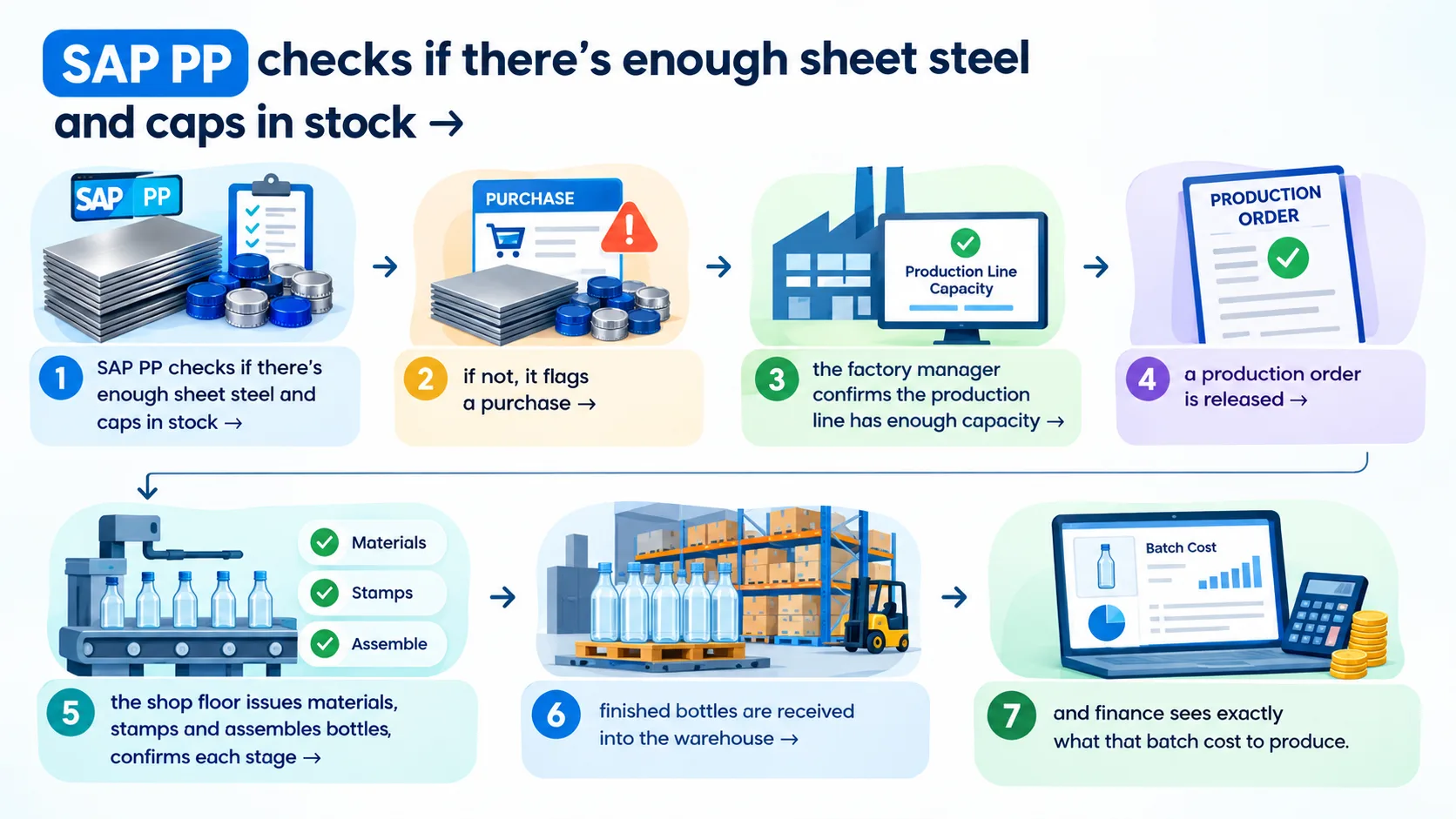
That entire chain, from forecast to finished stock, is the SAP PP cycle in action.
Who Should Actually Learn SAP PP?
If any of these sound like you, SAP PP is worth a serious look:
- Mechanical, production, or industrial engineering graduates who want a desk-based, system-driven career instead of a purely shop-floor role
- B.Com/BBA graduates who assumed SAP was “only for engineers”; functional consulting roles are open to any graduate who can learn business processes
- Working professionals in manufacturing, supply chain, or operations looking to move from execution roles into a specialized, better-paying track
- Career switchers from unrelated fields willing to put in a few focused months of structured learning before job-hunting
“But I Don’t Know Coding” And Other Doubts, Answered
Doubt: “I need to be technical to learn SAP.”
Not for PP. It’s configuration and process logic, not programming. If you can follow a flowchart and understand how a business decision gets made, you can learn it.
Doubt: “Will AI make SAP PP consultants irrelevant?”
Unlikely any time soon. AI is being layered into planning tools to improve forecasting accuracy, but someone still needs to configure, interpret, and manage that system for a specific business. That’s the consultant’s job.
Doubt: “I have zero work experience. Will companies even consider me?”
Entry-level “SAP PP Support Consultant” and “Associate Consultant” roles exist specifically for freshers who’ve completed structured training and understand the end-to-end cycle. You don’t need years of factory experience to start.

What Should a Good SAP PP Course Actually Cover?
Not every SAP PP course teaches the full picture. Before enrolling anywhere, check that the syllabus genuinely covers:
- Master data: Bill of Materials, routings, work centers
- Demand management and Sales & Operations Planning
- MRP configuration and live MRP runs
- Capacity planning and scheduling
- Production order creation, release, and confirmation
- Integration touchpoints with SAP MM, SD, and FICO
- Real system access you can actually click through, not just slides
This is exactly the sequence you just read above. A course that skips capacity planning or integration is only teaching you half the cycle, and that gap shows up fast in interviews. ICA Online’s SAP PP course, for instance, is structured around this same end-to-end flow with live system practice rather than theory alone, so learners walk in able to explain the cycle, not just recite it.
What Can You Earn After a SAP PP Course?
Real numbers help more than vague promises. According to Glassdoor’s India salary data, SAP PP consultants average roughly ₹5.5–5.6 lakh a year, with experienced professionals reporting packages upward of ₹16 lakh. PayScale’s broader data on SAP consultants with PP skills puts the average closer to ₹8 lakh, with mid-to-senior consultants at firms like Deloitte, Accenture, Capgemini, and IBM regularly earning well beyond that.
The pattern is consistent: SAP PP pays modestly at entry level and scales fast with experience and certification, which makes the first couple of years of upskilling worth the effort.
How to Actually Get Started
- Understand core manufacturing concepts first: BOM, routing, work centers. This makes the SAP part click faster.
- Pick a course that covers the full cycle, not just MRP or just order processing in isolation.
- Practice directly on a live or sandbox SAP system; reading about transaction codes isn’t the same as running them.
- Target an SAP certification once you’re confident with the process flow; it’s the credibility marker recruiters filter for.
- Build your resume around the cycle, not just tool names. “Configured MRP and capacity planning for a make-to-stock scenario” reads far stronger than “Learned SAP PP.”
If you’d rather not piece this together from scattered tutorials, a structured, mentor-guided program like the one at ICA Online can save you the trial-and-error phase worth checking out if you want a faster, more organized path in.
Few related topics for your knowledge
- SAP FICO Vs SAP HANA: Which Is Better
- Analyzing The Procure To Pay Process: A Comprehensive Overview
- How SAP FICO Works In Manufacturing Industry
- SAP FICO Transaction Codes: List Of T-Codes To Remember
- Why Smart Finance Pros Are Rushing To Learn SAP FICO
- 50+ SAP MM Interview Questions and Answers Revealed
Final Word
The SAP PP cycle isn’t some abstract corporate concept; it’s the actual sequence every factory follows to turn raw material into a product on a shelf, just digitized and standardized. Once you understand those eight steps, SAP PP stops being intimidating jargon and starts looking like what it actually is: a learnable, structured skill with a clear career path attached.
You don’t need an engineering degree, a coding background, or years of experience to start. You need the right starting point, and now you have it.
Frequently Asked Questions
1. What is the SAP PP cycle in simple words?
The SAP PP cycle is the step-by-step process SAP’s Production Planning module follows to turn a demand forecast into a finished, stocked product, covering demand planning, MRP, capacity checks, production orders, execution, and goods receipt.
2. Is SAP PP a good career option in 2026?
Yes. Manufacturing, automotive, pharma, and FMCG companies running SAP all need PP consultants to manage production planning, making it a steady, well-paying functional consulting career with strong long-term demand.
3. Do I need an engineering degree to learn SAP PP?
No. SAP PP is a functional, configuration-based role open to graduates from any stream commerce, business, or engineering as long as you understand business processes and are willing to learn manufacturing basics.
4. What is the difference between SAP PP and SAP MM?
SAP PP plans what, when, and how much to produce. SAP MM handles procuring and storing the raw materials needed for that production. The two modules work together throughout the SAP PP cycle.
5. How long does it take to learn SAP PP?
A focused, structured SAP PP course typically takes a couple of months to cover the full cycle and system practice, though real proficiency builds further through on-the-job exposure and certification.
- Data Science Course with Placement: Is It Worth It or Just Marketing? - October 9, 2026
- What is ITC in GST: The Complete Guide You Need - September 26, 2026
- SAP PP Cycle Explained: The Guide Every Fresher Should Read Before Choosing SAP - September 18, 2026