SQL Learning Course: Why This One Skill Could Change Your Career in 2026
Summary
An SQL learning course teaches you to organise, query, and extract insights from data a skill used by 59% of developers worldwide and in demand across almost every modern job. It’s beginner-friendly, takes weeks (not years) to get job-ready, and works for students, freshers, and career switchers alike.
You’ve probably heard this before: “Learn to code, or get left behind.” It’s overwhelming advice. Python, Java, cloud computing, AI where do you even start when everyone’s shouting about a different skill?
Here’s the thing nobody tells you: you don’t need to learn all of it. You need to learn the one skill that quietly sits underneath almost every data-driven job out there: SQL.
No fancy coding bootcamp. No CS degree. Just a few weeks of focused learning, and you’re speaking the language that banks, e-commerce companies, hospitals, and even your favourite food delivery app run on.
Let’s break down why an SQL learning course might be the smartest, least stressful career decision you make this year.
Table of Contents
- What Is SQL?
- Why Is Everyone Suddenly Talking About SQL?
- Who Should Take an SQL Learning Course?
- What Do You Actually Learn in SQL Training Online?
- SQL vs Excel: Which One Should You Learn First?
- What Salary Can You Realistically Expect?
- Real Scenario: Two Very Different Starting Points
- SQL Classes Online vs Free YouTube Tutorials: What’s the Difference?
- How Do You Choose the Right SQL Learning Course?
- Conclusion
- Frequently Asked Questions
What Is SQL?
SQL stands for Structured Query Language. It’s the standard language used to talk to databases the systems that store everything from your bank transactions to Swiggy’s order history to a hospital’s patient records.
In plain terms: if a company has data (and every company does), someone needs to know how to ask questions of that data. SQL is how you ask.
A simple example: Instead of scrolling through 50,000 rows in a spreadsheet to find “customers from Kolkata who spent over ₹5,000 last month,” you write one SQL query and get the answer in seconds.
Why Is Everyone Suddenly Talking About SQL?
It’s not sudden; SQL has quietly been the backbone of data work for over four decades. What’s changed is how visible that demand has become.
A few numbers worth knowing:
- SQL was used by 59% of developers in the 2025 Stack Overflow Developer Survey of 49,000+ professionals, right behind JavaScript, Python, and HTML/CSS.
- It’s one of the only languages that has topped the “most used” list every single year the survey has run, including years when it was ranked #1 overall.
- Roles that combine SQL with tools like Excel, Power BI, or Python think business analyst, data analyst, MIS executive consistently sit among the more stable, in-demand tech-adjacent careers in India.
Here’s the part students find surprising: SQL isn’t just for “developers.” Marketers use it to pull campaign data. Finance teams use it to reconcile reports. HR analysts use it to track attrition trends. It’s less a “coding skill” and more a data literacy skill, and that’s exactly why it’s spreading beyond IT departments.
Who Should Take an SQL Learning Course?
Short answer: almost anyone who touches data in their job, or wants to.
Students and freshers: SQL adds a concrete, provable skill to a resume that might otherwise just say “good with numbers” or “quick learner.” It’s something you can demonstrate in an interview with an actual query.
B.Com and finance graduates: If you’re already comfortable with numbers and Excel, SQL is a natural next step. It’s the difference between manually checking a ledger and running a query that flags every mismatched entry in seconds.
Career switchers: Coming from a non-tech background? SQL is widely considered one of the gentlest entry points into the data and analytics world, precisely because its syntax reads close to plain English (SELECT name FROM customers WHERE city = ‘Kolkata’ isn’t far from how you’d say it out loud).
Working professionals in ops, sales, or support: If your job involves pulling reports or waiting on someone else to “run the numbers” for you, SQL lets you stop waiting.
What Do You Actually Learn in SQL Training Online?
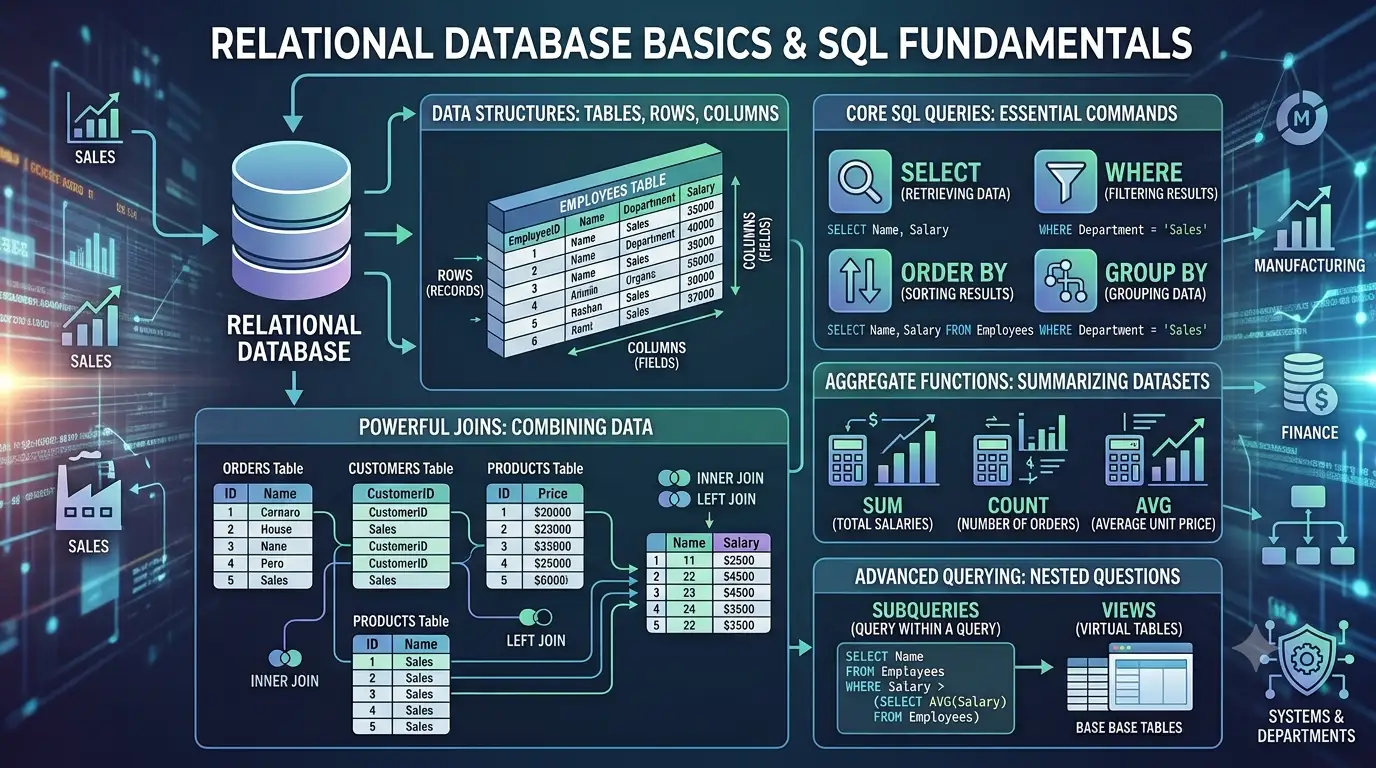
A solid SQL class online program typically moves through these stages:
- Database basics: understanding tables, rows, columns, and how relational databases are structured
- Core queries: SELECT, WHERE, ORDER BY, GROUP BY (the commands you’ll use daily)
- Joins: combining data from multiple tables, which is where SQL really starts feeling powerful
- Aggregate functions: SUM, COUNT, AVG, and other ways to summarise large datasets
- Subqueries and views: writing more advanced, layered questions for your data
- Real-world practice working with sample business datasets (sales records, HR data, inventory) instead of toy examples
Good programs don’t stop at syntax. They put you in front of messy, realistic data because that’s what the job actually looks like.
SQL vs Excel: Which One Should You Learn First?
This is one of the most common doubts students raise, so let’s settle it with a simple comparison.
| Factors | Excel | SQL |
|---|---|---|
| Best for | Small to medium datasets, quick calculations | Large datasets, millions of rows |
| Speed on big data | Slows down, can crash | Built for scale, stays fast |
| Combining data sources | Manual VLOOKUPs, error-prone | JOIN queries, clean and repeatable |
| Learning curve | Familiar, visual | Slightly more logical/structured |
| Career signal | Expected baseline skill | Differentiator on a resume |
The honest answer: you don’t have to pick one. Most working analysts use both Excel for quick, visual work, and SQL for anything at scale. But if you already know Excel and want to stand out, SQL is the natural next skill to stack on top.
What Salary Can You Realistically Expect?
Numbers vary by source, city, and experience, but here’s a grounded picture based on current Indian market data:
- Entry-level (0–1 year): roughly ₹3–4.5 LPA, based on PayScale and Indeed India data
- Early to mid-career (1–5 years): typically ₹4.5–8 LPA
- Senior professionals (5+ years): often ₹15–25 LPA, especially when SQL is paired with Power BI, Python, or cloud database tools like AWS or Azure SQL
A useful pattern across almost every salary report: SQL rarely stands alone. Professionals who pair it with Excel, Power BI, or a bit of Python tend to sit at the higher end of these ranges because they can not just pull the data, but also present and act on it.
Real Scenario: Two Very Different Starting Points
Student A, a final-year B.Com student: Worried her degree alone won’t be enough in a job market obsessed with “tech skills.” She adds an SQL learning course alongside her final semester. In interviews, instead of just listing “MS Excel” on her resume, she can now say she’s built queries on real sales datasets. That one line becomes a genuine talking point.
Student B, 6 years into a customer support role: Wants out, but doesn’t want to start from zero in a coding bootcamp. He picks up SQL and Power BI over a few months. Six months later, he moves into a reporting analyst role in the same industry, with better pay and far less repetitive work.
Neither of them became “developers.” Both became more useful, more hireable versions of themselves.
SQL Classes Online vs Free YouTube Tutorials: What’s the Difference?
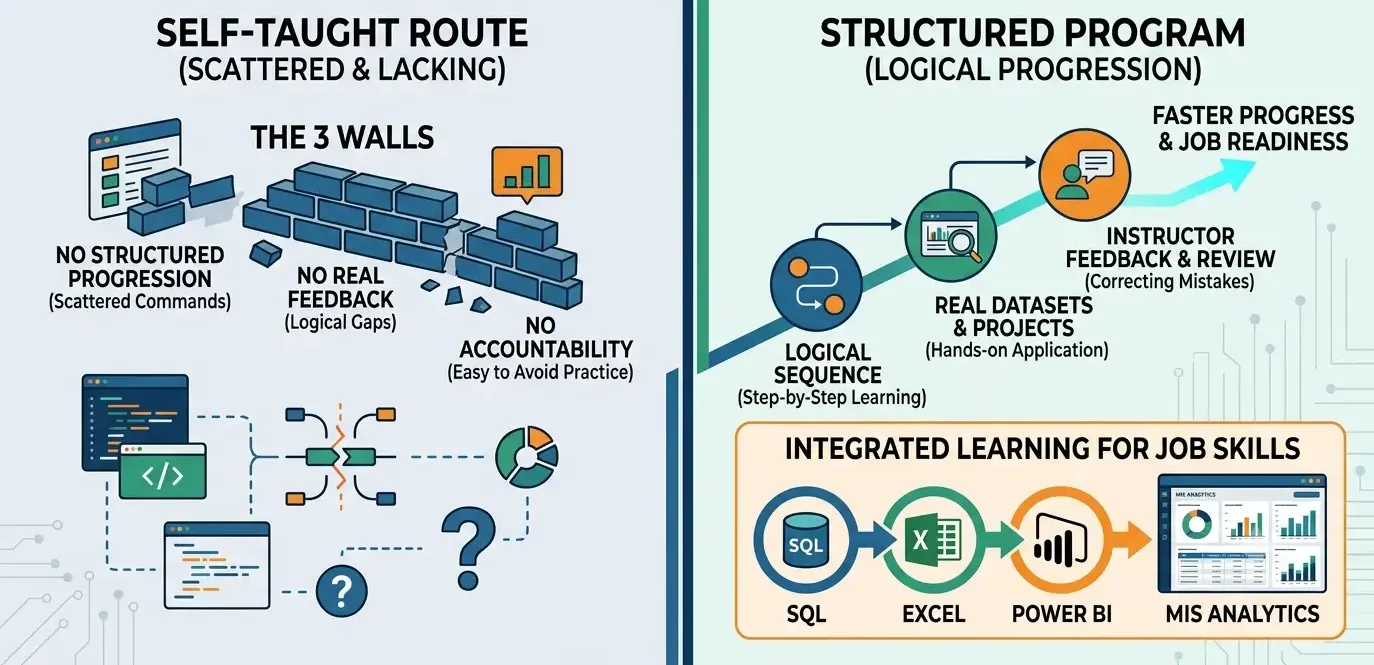
Free tutorials are genuinely useful for testing whether you enjoy working with data. But most students who try to go the fully self-taught route run into the same three walls:
- No structured progression: you learn scattered commands without understanding how they connect
- No real feedback: nobody checks whether your query logic actually makes sense
- No accountability: it’s easy to watch videos and never actually practise
A structured SQL training online program fixes exactly these gaps: a sequence that builds logically, practice on real datasets, and someone to flag your mistakes before an interviewer does.
If you’re the kind of learner who finishes what you start alone, YouTube is fine. If you’ve started three tutorials and finished none, structure will save you months.
For learners who want SQL taught alongside Excel and Power BI rather than in isolation, ICA Online’s MIS Analytics program bundles all three, which mirrors how the skill actually gets used on the job, where you’re rarely just writing queries in a vacuum.
How Do You Choose the Right SQL Learning Course?
Before enrolling anywhere, check for these four things:
- Hands-on datasets, not just slides; you should be writing queries from week one, not just watching someone else write them
- A path from basics to joins and subqueries, not a course that stops at SELECT and WHERE
- Doubt-clearing support: SQL logic trips people up; you want somewhere to ask “why did this query break?”
- Some connection to how it’s used at work: reporting, dashboards, or a related tool like Excel or Power BI, so the skill doesn’t sit isolated
Conclusion
You don’t need to learn everything the internet is telling you to learn. You need one skill that’s quietly essential everywhere, and SQL fits that description better than almost anything else in tech right now.
Whether you’re a student trying to stand out, a graduate figuring out your first real job, or someone mid-career looking for a way out of repetitive work, an SQL learning course is one of the lowest-risk, highest-return skills you can pick up this year.
Start small. Write your first query this week. You’ll be surprised how quickly “I don’t know how to code” turns into “I can actually work with data.”
Few MIS related topics for your knowledge
Frequently Asked Questions
1. Is SQL hard to learn for beginners?
Not really. SQL reads closer to plain English than most programming languages (SELECT * FROM students WHERE marks > 80). Most beginners can write basic queries within the first week and move to joins and grouping within a month of regular practice.
2. How long does it take to learn SQL?
Job-ready basics usually take 4–8 weeks of consistent practice. Comfort with joins, subqueries, and real datasets typically takes 2–3 months. Mastery comes from ongoing use on actual work projects, not from any single course.
3. Can I get a job with just SQL skills?
Yes, for entry-level data or reporting roles, but pairing SQL with Excel, Power BI, or a BI tool significantly widens your options and pay range. Most job postings list SQL as one required skill among two or three, not the only one.
4. Is SQL still relevant now that AI tools can write queries?
Yes. AI tools can draft queries, but you still need to know if the output is correct, efficient, and asking the right question. Understanding SQL is what lets you verify and fix AI-generated queries; it’s making SQL literacy more valuable, not less.
5. Do I need a coding background before starting an SQL course?
No. SQL is one of the most common starting points for people with zero programming experience, including commerce and non-tech graduates. Basic comfort with logical thinking (the kind Excel formulas already use) is enough to begin.
- Data Science Course with Placement: Is It Worth It or Just Marketing? - October 9, 2026
- What is ITC in GST: The Complete Guide You Need - September 26, 2026
- SAP PP Cycle Explained: The Guide Every Fresher Should Read Before Choosing SAP - September 18, 2026