Accounting Courses Online with Certificate: Your 2026 Career Launchpad
Summary
Looking for the fastest way to launch a finance career? Enrolling in structured online accounting courses with certificate programs is the most reliable way to gain and validate corporate-ready skills in 2026. High-quality online accounting courses bridge the gap between academic theory and practical execution. They teach you to master real-world tools like Tally Prime, GST compliance, and ITR, helping you secure high-paying roles in a supply-constrained job market.
You are scrolling through LinkedIn, job boards, or corporate career pages. Every single entry-level opening seems to demand two to three years of experience. You have a degree, or perhaps you are working hard to finish one, but your textbooks feel light-years away from what companies actually do.
The fear of getting stuck in a dead-end job or failing to clear a technical interview can be paralyzing. If you are trying to switch careers, the anxiety is even worse: Am I too late? Will I have to start all over again from zero?
Here is a liberating truth: The corporate world doesn’t care about how many textbook chapters you memorized. It cares about what you can execute on day one.
The global finance market is experiencing a massive paradox. While thousands of graduates struggle to find work, financial leaders are facing a critical talent shortage. A 2026 Robert Half hiring report revealed that 74% of finance managers plan to aggressively expand headcount, yet a staggering 75% report severe skills shortages that delay critical business projects.
The jobs are waiting for you. You just need the right toolkit to unlock them.
Table of Contents
- What is an Online Accounting Certification Course?
- Why are Accounting Courses Online with Certificate Programs Exploding in 2026?
- Which Skills Do Companies Actually Fight Over?
- Which Online Platform is Best for Your Accounting Career?
- How to Choose the Right Online Accounting Course?
- Conclusion: Stop Waiting, Start Building Your Future
- Frequently Asked Questions
What is an Online Accounting Certification Course?
Before diving into the mechanics of the market, let’s establish a clear definition.
In the modern corporate ecosystem, these certifications serve as a digital passport. They tell a recruiter that you don’t just know the theoretical definition of a balance sheet—you know how to build, analyze, and troubleshoot one using the exact software they use every day.
Why are Accounting Courses Online with Certificate Programs Exploding in 2026?
You might wonder if automation or Artificial Intelligence is going to erase accounting jobs. The short answer is: No. It is simply changing the rules of the game.
The era of manual, repetitive data entry is fading. According to recent 2026 industry data from Accounting Seed, manual compliance tasks are being heavily automated, shifting the human accountant’s role from a “number cruncher” to a “strategic advisory partner.” Companies no longer need people to type numbers into a spreadsheet; they need professionals who can look at the automated numbers, spot anomalies, ensure tax compliance, and explain what those figures mean for business growth.
By choosing specialized online accounting courses, you position yourself on the right side of this tech shift.
Memorizes raw accounting theories
Lacks hands-on software training
Struggles with practical tax laws
Uses TallyPrime & SAP fluidly
Manages e-filing & GST compliance
Drives data-backed business choices
When you hold a recognized certification, you gain three massive advantages:
- Instant Credibility: Your resume instantly passes automated Applicant Tracking Systems (ATS) screening filters that look for specific software keywords.
- Practical Authority: You learn how to file real Goods and Services Tax (GST) returns, manage payroll, and handle corporate audits.
- Risk Mitigation: Employers feel safe hiring a certified candidate because the certificate guarantees a baseline standard of operational knowledge.
Which Skills Do Companies Actually Fight Over?
If you want to maximize your earning potential, you cannot afford to waste time on outdated curricula. The highest-paying entry-level positions require a blend of technical mastery and regulatory understanding. Look for programs that emphasize these three core pillars:
1. Enterprise Software Mastery (Tally Prime & SAP)
Every modern business operates on an Enterprise Resource Planning (ERP) platform. Tally Prime is the financial backbone for millions of small and medium-sized enterprises, while SAP (modules such as SAP MM or FICO) powers multinational corporations. If your resume shows you can manage inventory, track vendors, and run general ledgers inside these systems, your job search shortens drastically.
2. Practical Taxation and GST Compliance
Tax laws shift constantly. Knowing how to calculate tax on a sheet of paper is useless if you do not know how to navigate the official government e-filing portals. Employers actively seek individuals who can comfortably handle monthly GST reconciliations, track input tax credits, and manage payroll processing without making costly legal mistakes.
3. Financial Data Interpretation
As AI handles basic bookkeeping, your value lies in analysis. Can you look at a cash flow statement and identify why a company is running out of money despite showing high sales? Can you clean up data errors using Microsoft Excel or Power BI? These analytical skills turn a low-paid clerk into an indispensable corporate asset.
Which Online Platform is Best for Your Accounting Career?
When searching for the right accounting courses online with certificate programs, the sheer number of options can feel overwhelming. Different platforms serve completely different career goals. To make your choice easier, let’s break down how the top global and specialized education platforms stack up in 2026 based on curriculum depth, practical application, and job-market value.
1. Coursera
Coursera partners with elite global universities (like the University of Pennsylvania and the University of Illinois) and financial institutions to offer highly structured learning paths.
- Top Programs: Introduction to Finance and Accounting Specialization (Wharton) or the Intuit Academy Bookkeeping Professional Certificate.
- The Verdict: Exceptional for learning global standards, foundational definitions, and earning university-backed credentials. However, because it targets a global audience, it rarely covers country-specific taxation frameworks or localized corporate laws.
2. Udemy
Udemy operates as a massive marketplace of individual, creator-led video courses, allowing you to learn hyper-specific skills on demand.
- Top Programs: Individual bootcamps focused entirely on QuickBooks, basic Tally ERP, or Advanced Excel formulas.
- The Verdict: Highly affordable with lifetime access, making it great for troubleshooting a specific tool or learning at a purely self-paced speed. The downside is that individual certificates carry less weight with corporate HR screening tools, and there is no direct job placement support.
3. ACCA-X & edX
If your ultimate goal is to work for multinational corporations or transition into high-level advisory roles, edX (in partnership with institutions like the New York Institute of Finance) and ACCA-X offer premium paths.
- Top Programs: Financial Accounting Professional Certificate or ACCA Foundation-level prep courses.
- The Verdict: Outstanding global brand value for your LinkedIn profile or resume. However, these programs require a heavy time commitment (often 3 to 9 months) and carry premium price tags, making them less ideal for freshers needing immediate local employment.
4. ICA Online
While global platforms excel at teaching broad concepts, they often leave a massive gap between video lectures and localized, day-to-day corporate expectations. This is where specialized, outcome-driven platforms fill the void.
- Top Programs: Certified Industrial Accountant Plus (CIA+) and specialized Tally Prime + GST Compliance modules.
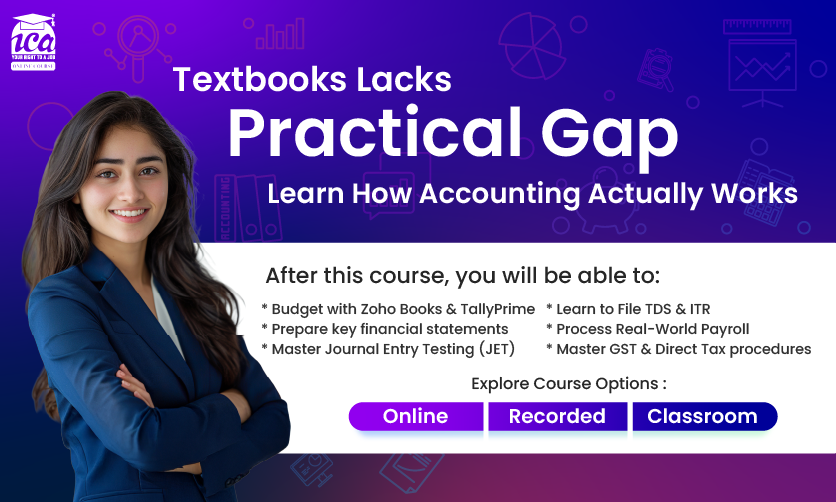
- The Verdict: Unlike standard marketplace sites, ICA Online tailors its online accounting courses specifically to align with current hiring demands. Instead of just watching pre-recorded videos, students engage in hands-on simulation tools that replicate actual corporate ledgers, business tax filings, and SAP ERP ecosystems. Combined with rigorous interactive mock interviews and dedicated placement support, it functions less like a video library and more like a direct pipeline into entry-level corporate finance roles.
ICA Online — Accounting Course
Stop reading about accounting courses, start doing it
How to Choose the Right Online Accounting Course?
Not all digital programs are created equal. Avoid the trap of buying cheap, pre-recorded video libraries that offer zero human interaction. To get a true return on your investment, pick a course that provides:
- Live, Interactive Learning: You need the ability to ask questions in real-time when a complex accounting adjustment confuses you.
- Hands-on Simulation Labs: You should be working on simulated corporate data, solving real business case studies, and fixing messed-up ledgers.
- Industry-Recognized Faculty: Learn from active Chartered Accountants (CAs) or corporate finance heads who know exactly what current employers ask in interviews.
- Robust Placement Assistance: The best institutes don’t just wave goodbye when you pass your exam; they actively connect you with corporate recruitment networks.
Conclusion: Stop Waiting, Start Building Your Future
The job market can feel intimidating when you are standing on the outside looking in. But remember: every industry giant, every local startup, and every e-commerce brand requires clean, compliant, and strategic financial management to survive. They are actively looking for you, provided you speak the language of modern business.
Enrolling in comprehensive accounting courses online with certificate programs transforms you from a hopeful job seeker into a highly specialized solution provider. Don’t let another month slip by while you second-guess your career path.
Few insightful articles for your knowledge:
- Income From House Property: A Guide To The Tax Payer
- Top 30 Journal Entries Questions And Answers
- Can Science Students Become An Accountant?
- All You Need To Know About Audit Trail In Zoho Books
- What Is General Ledger Accounting And How Does It Work?
- Guide To AI In Accounting: Trends, Tools, And Stats
Frequently Asked Questions
1. Can I get an accounting job if I complete an accounting course online with a certificate?
Yes, absolutely. Modern employers prioritize functional skills over traditional degrees. If your online certification includes practical, hands-on training in real-world tools like Tally Prime, SAP, and advanced Excel, you will be highly competitive for entry-level roles like Accounts Executive, Tax Analyst, or Bookkeeper.
2. Which online accounting courses are most valued by employers in 2026?
The most valued courses are those focusing on practical applications rather than pure theory. Programs that offer verified certifications in Tally Prime, GST compliance, customized corporate accounting workflows, and specialized ERP software like SAP hold the maximum weight on a resume in today’s tech-driven job market.
3. Do I need a commerce or math background to join online accounting courses?
Not at all. Most foundational online programs are constructed to guide you from absolute scratch. They break down basic accounting principles using everyday language before advancing to software training. A logical mindset and a willingness to learn are far more critical than your previous academic stream.
4. How does learning SAP or Tally improve my career progression in finance?
Manual data entry jobs are shrinking, but the demand for professionals who can manage complex ERP software is skyrocketing. Knowing SAP or Tally positions you as a tech-fluent financial asset. It allows you to skip low-paying clerk positions and land straight in structured corporate executive roles with much faster promotion cycles.
5. What is the average duration to finish a professional accounting certificate online?
Depending on the depth of the curriculum and your personal weekly schedule, most comprehensive certification programs take anywhere from 3 to 6 months to complete. This timeline gives you sufficient hours to master the theoretical concepts, practice in software simulation modules, and complete real-world case projects.
- Data Science Course with Placement: Is It Worth It or Just Marketing? - October 9, 2026
- What is ITC in GST: The Complete Guide You Need - September 26, 2026
- SAP PP Cycle Explained: The Guide Every Fresher Should Read Before Choosing SAP - September 18, 2026