How Artificial Intelligence Is Transforming the Accounting Profession
Quick Summary
Artificial Intelligence in accounting automates tasks like bookkeeping, invoice processing, fraud detection, and financial forecasting. With the global AI in accounting market projected to reach $68.75 billion by 2031, finance professionals must upskill now. AI doesn’t replace accountants; it redefines their roles toward strategy, analysis, and advisory functions.
Imagine spending three weeks of your year doing nothing but entering data into spreadsheets, matching invoices, and reconciling transactions, only to find out a piece of software could have done all of it in three hours.
That’s not a futuristic scenario. That’s the reality hitting accounting departments right now.
If you’re a student eyeing a career in finance, a fresher just stepping into your first accounting role, or a seasoned professional wondering whether your skills will still be relevant five years from now, this article is written for you.
Let’s cut through the noise and talk honestly about what artificial intelligence in accounting actually means, what’s changing, what’s not, and most importantly, what you should do about it.
Table of Contents
- The Shift from Manual Processes to AI-Powered Accounting
- Key Areas Where AI Is Replacing Traditional Accounting Tasks
- Why Accountants Must Adapt to Artificial Intelligence Now
- Core Applications of Artificial Intelligence in Accounting
- Top AI Accounting Software Transforming Finance Teams
- Upskilling With an Artificial Intelligence in Accounting Course
- Artificial Intelligence in Accounting: Challenges and Ethical Considerations
- The Future of Artificial Intelligence in Accounting
- Conclusion
- Frequently Asked Questions
The Shift from Manual Processes to AI-Powered Accounting
Not too long ago, accounting meant stacks of ledger books, rooms full of clerks, and hours of painstaking manual entry. Then came computers. Then spreadsheets. Then, cloud software.
And now? AI.
Here’s what makes this shift different from every previous one: AI doesn’t just do things faster. It learns, adapts, and makes decisions often better than a human doing the same repetitive task for the hundredth time.
The numbers tell the story clearly. The global AI in accounting market was valued at $7.5 billion in 2025. By 2026, it’s already at $10.87 billion. And by 2031, analysts project it will hit $68.75 billion, representing a staggering 44.6% compound annual growth rate (CAGR). (Source: Market research projections, 2025)
That’s not a trend. That’s a transformation.
Key Areas Where AI Is Replacing Traditional Accounting Tasks
AI isn’t coming for accounting jobs, but it is absolutely coming for accounting tasks. There’s a crucial difference there, and we’ll unpack it throughout this article.
Here are the core tasks that AI is already handling or beginning to take over:
- Data entry and transaction recording are automated with near-zero error rates
- Bank reconciliation is matched in real time instead of end-of-month
- Invoice processing read, validated, and approved without human touch
- Expense categorisation sorted by AI based on historical patterns
- Compliance checks are flagged automatically against regulatory rules
- Basic financial reporting is generated on demand, not quarterly
Think of it this way: if a task can be described as routine, repetitive, and rule-based, AI can probably do it faster and more accurately than a human.
Why Accountants Must Adapt to Artificial Intelligence Now
Here’s a wake-up call wrapped in a statistic: according to The State of AI in Accounting 2026 Report, 92% of accounting professionals are already using AI tools in some form. That means if you’re not engaging with AI, you’re already in the minority even within your own profession.
The question isn’t whether AI will affect your accounting career. It already is. The question is whether you’re going to lead that change or be caught off guard by it.
Firms that have trained their staff on AI tools are saving up to 7 weeks per employee per year in productivity. (Source: Industry upskilling data, 2025) That’s nearly two months redirected from low-value tasks to high-value thinking analysis, client advisory, and strategic planning.
The accountants who thrive over the next decade won’t be the ones who fought AI. They’ll be the ones who learned to work alongside it.
Core Applications of Artificial Intelligence in Accounting
AI in Bookkeeping and Transaction Categorisation
Traditional bookkeeping is time-consuming by nature. Every transaction has to be captured, coded, and categorised, and even a small error can cascade into bigger problems during audits or tax season.
AI-powered bookkeeping tools use machine learning to read and categorise transactions automatically. The more data they process, the smarter they get. Over time, the system learns your business’s patterns, what a supplier payment looks like versus a payroll run, or how to treat a mixed-use expense.
For small businesses and large enterprises alike, this means month-end close processes that used to take weeks can now be completed in days.
Automated Invoice Processing and Accounts Payable
This is one of the most immediate and visible wins for AI in accounting. AI can extract data from invoices regardless of format, cross-reference them against purchase orders, flag discrepancies, and route them for approval, all without a human touching a keyboard.
Consider a mid-sized company that processes 2,000 invoices a month. Manually, that might take a team of three people a full week. With AI? It’s done in hours, with an audit trail that’s cleaner than any manual process.
AI-Driven Financial Forecasting and Predictive Analytics
One of the most exciting shifts AI brings is moving accounting from backwards-looking to forward-looking. Traditional accounting tells you what happened. AI-powered forecasting tells you what’s likely to happen next.
By analysing historical financial data, market trends, and even external economic signals, AI models can generate revenue forecasts, cash flow projections, and budget scenarios with far greater accuracy than spreadsheet-based models.
This is where accountants become strategic partners to leadership, not just scorekeepers, but advisors.
Fraud Detection and Risk Management Using AI
Fraud is expensive, and often invisible until it’s too late. AI changes that.
Machine learning models can scan millions of transactions and identify anomalies, unusual patterns, outlier amounts, and suspicious timing that would take a human auditor months to find, if they found them at all. Banks have used AI fraud detection for years. Now the same capability is coming to accounting teams of all sizes.
For companies, this means lower risk. For accounting professionals who understand how to configure and interpret these systems, it means a higher-value, more strategic role.
Real-Time Reporting and Intelligent Dashboards
Gone are the days of waiting until quarter-end to understand your financial position. AI-powered systems generate live dashboards that update in real time, pulling from connected data sources, bank feeds, POS systems, payroll platforms, and more.
CFOs and finance directors can now walk into a Monday morning meeting with a complete, accurate picture of the company’s financial health, not a snapshot from three weeks ago.
Top AI Accounting Software Transforming Finance Teams
What to Look for in AI Accounting Software
Before diving into specific platforms, it’s worth knowing what separates genuinely intelligent accounting software from tools that just slap “AI” on their marketing page.
Look for:
- Automated reconciliation: Does it match transactions without manual input?
- Natural language querying: Can you ask it questions in plain English?
- Predictive capabilities: Does it forecast, not just report?
- Integration ecosystem: How well does it connect with your existing tools?
- Auditability: Can you trace every AI decision back to its source data?
Leading AI Accounting Software Platforms Compared
| Platform | Key AI Strengths | Best For |
|---|---|---|
| QuickBooks AI | Smart categorisation, cash flow predictions | SMEs and freelancers |
| Xero | Bank reconciliation, payroll automation | Growing businesses |
| Sage Intacct | Predictive analytics, audit automation | Mid-market enterprises |
| Oracle NetSuite | End-to-end finance automation | Large enterprises |
| Vic.ai | Invoice automation, AP workflows | AP-heavy teams |
| Zoho Books | AI-assisted reporting and forecasting | Cost-conscious SMEs |
No single platform wins across every scenario. Your choice depends on your company’s size, existing tech stack, and specific pain points.
How AI Accounting Software Integrates with Existing Systems
One concern many finance teams raise is: “We already have systems in place. How disruptive is implementation?”
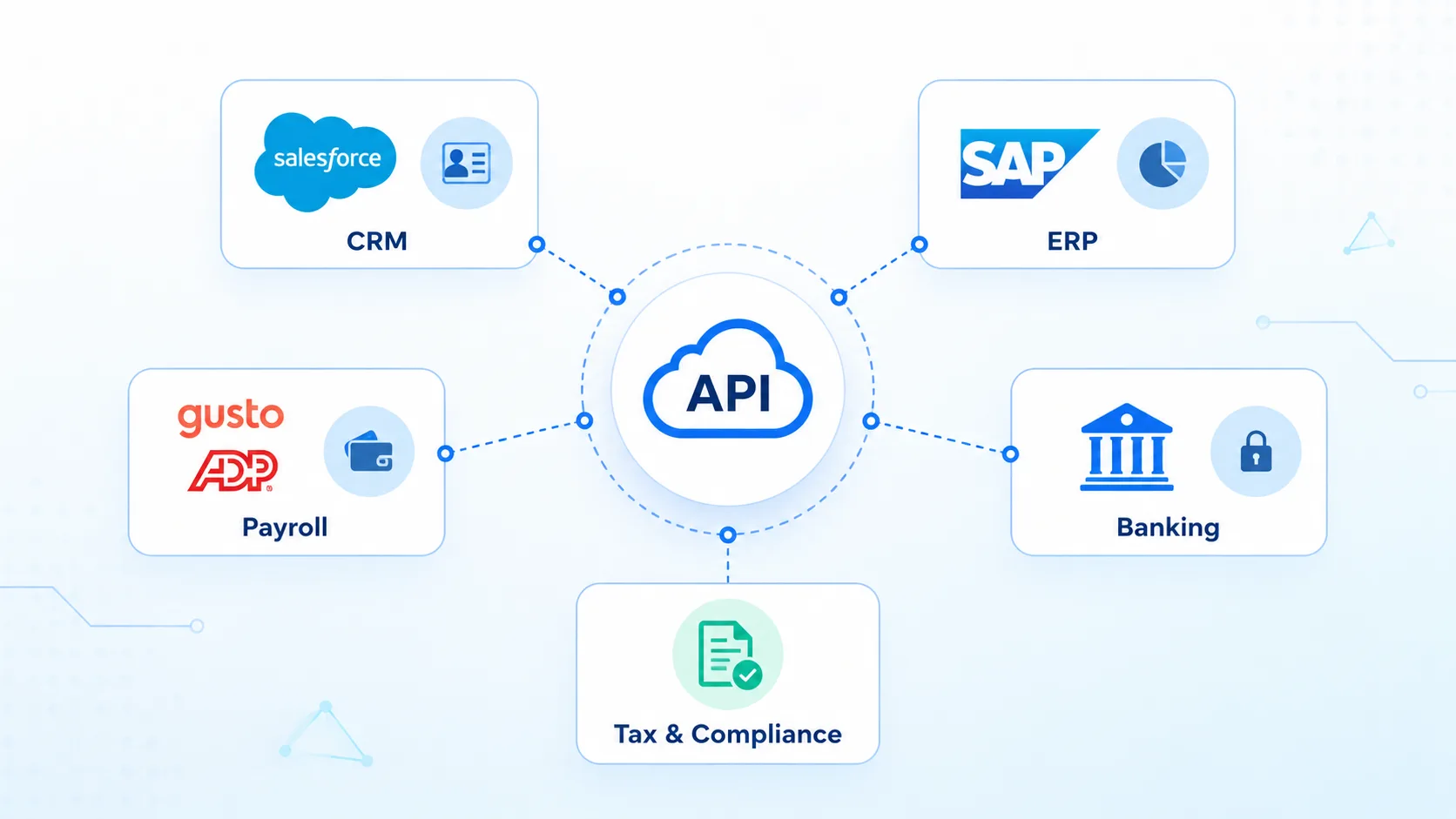
Modern AI accounting software is built with integration in mind. Most platforms connect seamlessly with:
- CRM tools like Salesforce
- ERP systems like SAP or Microsoft Dynamics
- Payroll platforms like ADP or Gusto
- Banking institutions via open banking APIs
- Tax software and compliance tools
The transition doesn’t have to be a rip-and-replace operation. Many teams run AI tools alongside existing systems during a transition period.
Cloud-Based vs On-Premise AI Accounting Software
For most small to mid-sized businesses, cloud-based is the obvious choice with lower upfront cost, automatic updates, and accessibility from anywhere.
For large enterprises with strict data governance requirements, particularly in banking, healthcare, or government, on-premise solutions offer greater control, though at significantly higher cost and maintenance overhead.
The trend is overwhelmingly toward the cloud. Even traditionally conservative industries are making the move.
Upskilling With an Artificial Intelligence in Accounting Course
Why Finance Professionals Are Enrolling in AI Accounting Courses
There’s a pattern playing out right now across finance departments globally. A junior accountant who understands AI tools gets promoted over a senior colleague who doesn’t. A CFO who can speak confidently about predictive analytics commands more respect in the boardroom. A fresher who lists AI accounting skills on their CV gets called back when others don’t.
The evidence is in the hiring data, the salary surveys, and the conversations happening in every major accounting firm right now.
The good news? You don’t need a computer science degree to upskill in AI for accounting. You need the right course, taught with the right context for finance professionals.
What a Quality Artificial Intelligence in Accounting Course Should Cover
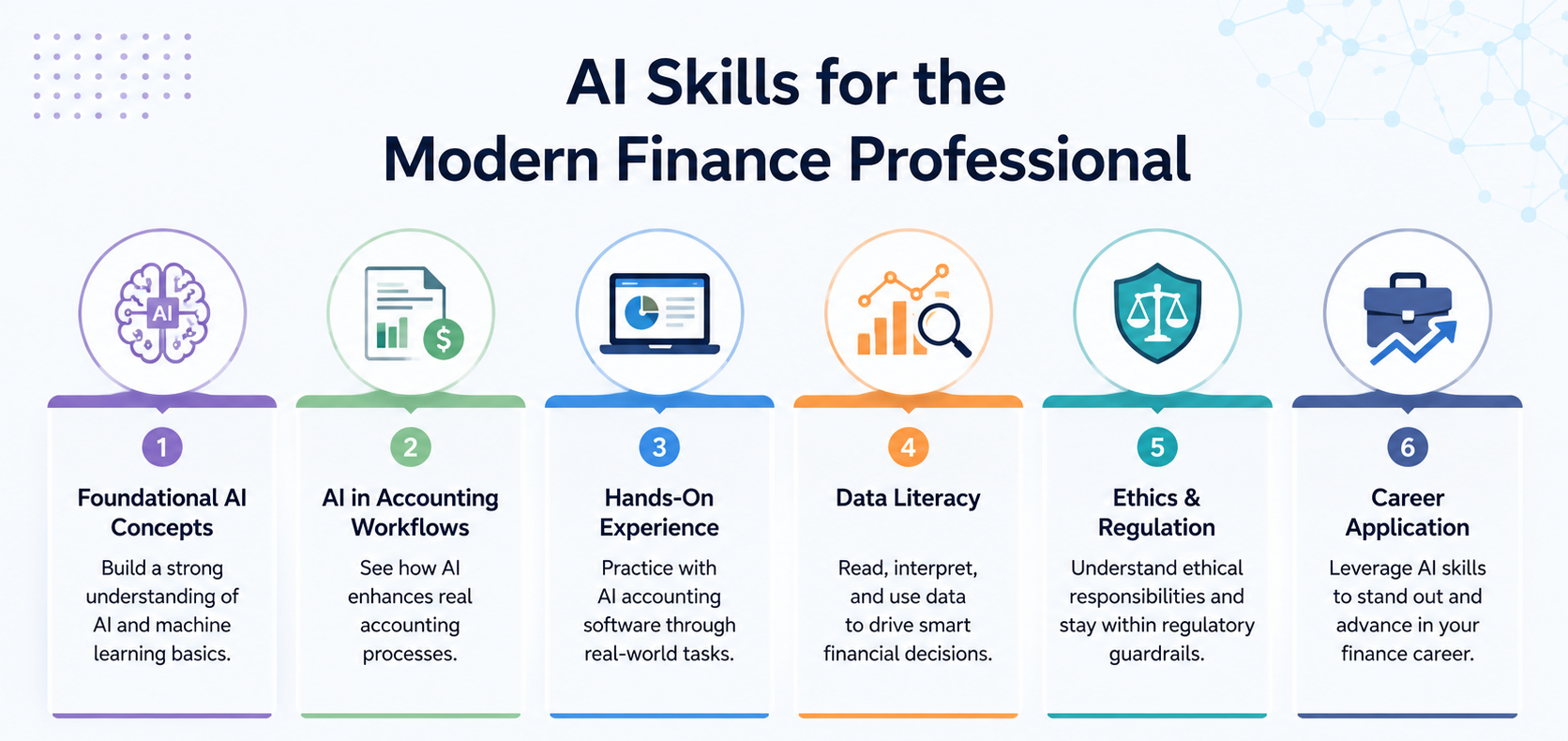
Not all courses are created equal. Before enrolling anywhere, make sure the curriculum addresses:
- Foundational AI and machine learning concepts without requiring a technical background
- How AI applies specifically to accounting workflows, not generic AI theory
- Hands-on experience with AI accounting software practice, not just lectures
- Data literacy for finance professionals: Reading, interpreting, and using data effectively
- Ethical and regulatory considerations: Understanding the guardrails
- Career application: How to position these skills in the job market
How ICA’s Artificial Intelligence in Accounting Course Is Structured
If you’re looking for a structured, career-focused path into AI for accounting, ICA Online offers a purpose-built course specifically for accounting and finance professionals. The programme is designed for people who understand accounting but want to understand how AI is reshaping it, not for people trying to become data scientists.
The curriculum blends conceptual grounding with practical application, covering everything from AI-powered bookkeeping to predictive financial modelling and compliance considerations, all taught in the context of real accounting scenarios. It’s one of the few programmes that genuinely bridges the gap between traditional accounting education and the AI-powered future of the profession.
Prefer watching over reading? Check out the video below!
Career Outcomes After Completing an AI Accounting Course
Completing an AI-focused accounting course opens doors that traditional qualifications alone simply don’t anymore:
- Financial Analyst (AI-assisted) using predictive tools to support investment and business decisions
- AI Implementation Consultant helping firms adopt and integrate AI accounting software
- Data-Driven CFO leading finance strategy with real-time analytics
- Forensic Accountant leveraging AI fraud detection capabilities
- Accounting Technology Specialist, the growing role of managing AI tools within finance teams
Salaries for roles that combine accounting expertise with AI skills are consistently commanding 20–35% premiums over traditional accounting roles in comparable positions.
You should seriously consider an AI accounting course if:
- You’re a CPA who wants to remain competitive in a changing landscape
- You’re a CFO or finance director looking to lead digital transformation
- You’re a fresher entering accounting and want a competitive edge from day one
- You’re an accounting team manager responsible for your team’s productivity
- You’re a career switcher from another finance role, looking to specialise
Artificial Intelligence in Accounting: Challenges and Ethical Considerations
Data Privacy and Security Risks in AI Accounting Software
AI systems are only as trustworthy as the data they’re trained on, and accounting data is among the most sensitive information a business holds. Payroll figures, tax filings, cash positions, banking credentials, all of this flows through AI accounting platforms.
Key concerns include:
- Data breaches: Cloud platforms are attractive targets for cybercriminals
- Third-party data sharing: Understanding what vendors do with your data
- Model bias: AI trained on flawed historical data can perpetuate those flaws
- Auditability: Can you explain an AI-generated decision to a regulator?
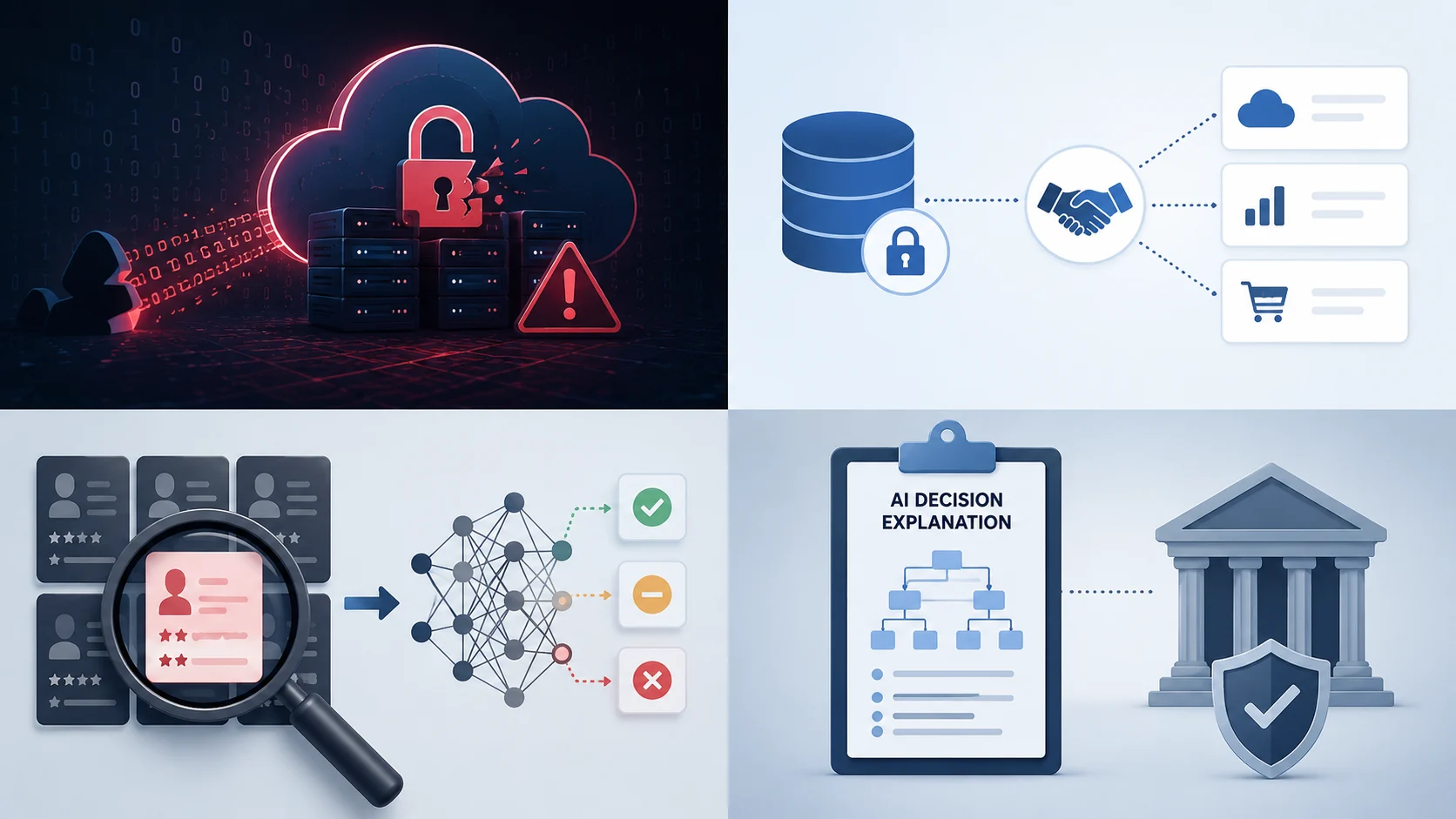
The solution isn’t to avoid AI, it’s to choose vendors who take security seriously and to build internal governance around AI use.
Overcoming Resistance to AI Adoption in Finance Teams
Here’s something nobody talks about enough: the biggest barrier to AI adoption in accounting isn’t the technology. It’s the people.
Fear of job loss, scepticism about software reliability, and simply not understanding how the tools work are the real friction points. Change management is as important as technical implementation.
Firms that succeed with AI adoption do three things well: they communicate the why clearly, they involve their teams in the process rather than imposing it, and they invest in training so people feel equipped rather than threatened.
Regulatory and Compliance Concerns Surrounding AI in Accounting
Regulators are watching AI in finance closely and rightfully so. Key areas of concern include:
- GDPR and data protection: Especially for European clients and operations
- IFRS and GAAP compliance: Ensuring AI-generated reports meet accounting standards
- Audit trail requirements: Every automated decision must be traceable
- Tax authority scrutiny: Some jurisdictions are beginning to audit AI-assisted tax filings
Staying ahead of these concerns is part of what makes a well-structured AI accounting course valuable. The regulatory landscape is moving fast, and professionals need to keep up.
The Future of Artificial Intelligence in Accounting
Emerging AI Technologies Shaping the Next Decade of Accounting
The AI tools of 2026 are impressive. The tools of 2031 are going to be transformative. Here’s what’s coming:
- Generative AI for financial narratives: AI that writes the management commentary alongside the numbers
- Autonomous close processes: Month-end that happens automatically, without a team working overtime
- AI-powered tax planning: Proactive optimisation rather than reactive filing
- Voice-driven financial querying: “Hey, what’s our EBITDA this quarter?” asked out loud and answered instantly
- Blockchain + AI integration: Immutable transaction records with intelligent analysis layered on top
Few insightful articles for your knowledge:
- Income From House Property: A Guide To The Tax Payer
- Top 30 Journal Entries Questions And Answers
- Can Science Students Become An Accountant?
- All You Need To Know About Audit Trail In Zoho Books
- What Is General Ledger Accounting And How Does It Work?
- Guide To AI In Accounting: Trends, Tools, And Stats
Will AI Replace Accountants or Redefine the Role?
Let’s be direct about this, because it’s the question on everyone’s mind. AI will not replace accountants. It will replace accountants who refuse to adapt to AI.
The profession is shifting from execution to interpretation. From data gathering to data storytelling. From compliance checking to strategic advisory.
The accountants of the future will spend less time processing and more time thinking. Less time entering data and more time explaining what that data means for the business. That’s not a threat to the profession; it’s an elevation of it.
But that elevation only happens for the professionals who are ready for it.
Conclusion
The accounting profession isn’t disappearing; it’s evolving faster than at any point in its history. Artificial intelligence in accounting is not a distant possibility or a theoretical concern. It’s the daily reality for 92% of accounting professionals already using AI tools in some form.
The global market is on a trajectory that will see it grow nearly tenfold in six years. Firms investing in AI training are reclaiming weeks of productivity per employee. The software exists, the demand is clear, and the career opportunities for AI-literate accounting professionals are genuinely significant.
What’s left is the decision: are you going to engage with this shift proactively, or wait until the profession moves without you?
If you’re ready to take the next step, explore what a structured AI accounting course looks like, not because it’s a trend, but because it’s the most practical investment you can make in your accounting career right now.
Frequently Asked Questions
1. What is artificial intelligence in accounting?
AI in accounting uses machine learning and automation to handle bookkeeping, invoicing, forecasting, and fraud detection, reducing manual work and shifting accountants toward strategic, high-value roles.
2. Will AI replace accountants?
No. AI automates repetitive tasks, not accountants. 92% already use AI tools. Those who adapt move into advisory and analytical roles; the profession evolves, it doesn’t disappear.
3. What should I look for in an artificial intelligence in accounting course?
Look for AI fundamentals, accounting-specific applications, hands-on software training, data literacy, and regulatory coverage taught for finance professionals, not computer scientists.
4. What is the best AI accounting software available in 2026?
op platforms: QuickBooks AI (SMEs), Xero (growing firms), Sage Intacct (mid-market), Oracle NetSuite (enterprises), Vic.ai (invoice automation). The best choice depends on your business size and needs.
5. How big is the AI in the accounting market, and why does it matter for my career?
The market grows from $7.5B (2025) to $68.75B (2031) at 44.6% CAGR. AI-literate accountants earn more and advance faster. Upskilling now gives you a serious competitive edge.

- Data Science Course with Placement: Is It Worth It or Just Marketing? - October 9, 2026
- What is ITC in GST: The Complete Guide You Need - September 26, 2026
- SAP PP Cycle Explained: The Guide Every Fresher Should Read Before Choosing SAP - September 18, 2026