SAP MM Internship for Freshers: A Career Guide For Future
SAP MM internship for freshers is no longer just a “learning phase”, rather it is a strategic career launchpad. Recruiters at top-tier firms like Deloitte, Accenture, and Reliance are no longer asking if you are certified; they are asking how many end-to-end configuration cycles you have executed. In the volatile industrial landscape of 2026, the global supply chain has moved from reactive to predictive. At the centre of this transformation is SAP S/4HANA Materials Management (MM). For a fresher, the leap from a university degree to a corporate ERP role can feel like an abyss. This guide is a comprehensive deep dive into mastering the module, securing a high-stipend internship, and skyrocketing your long-term salary potential.

Table of Contents
- 1. Defining SAP MM in the Age of S/4HANA
- 2. The Technical Core: Procure-to-Pay (P2P) Cycle
- 3. Mastering SAP MM Master Data: The Technical Foundation
- 4. The 180-Day SAP MM Internship Success Roadmap
- 5. SAP MM Roles and Responsibilities: End-User vs Consultant
- 6. SAP MM Salary Trends in India (2026)
- 7. How to Get an SAP MM Job Without Experience
- 8. Conclusion: Strategic Career Execution
- 9. Frequently Asked Questions
1. Defining SAP MM in the Age of S/4HANA
SAP Materials Management (MM) is the functional backbone of the SAP ecosystem. It manages the entire lifecycle of a material—from the moment a requirement is identified to the final payment to the vendor.
-
Why SAP MM is Recession-Proof
Every industry, be it a pharmaceutical giant producing vaccines or an automotive leader like Tata Motors, requires raw materials. If the procurement process fails, the production line stops. This is why SAP MM job opportunities remain consistently high. In 2026, with the integration of AI-driven procurement, the role has evolved from data entry to Strategic Sourcing Optimisation.
2. The Technical Core: Procure-to-Pay (P2P) Cycle
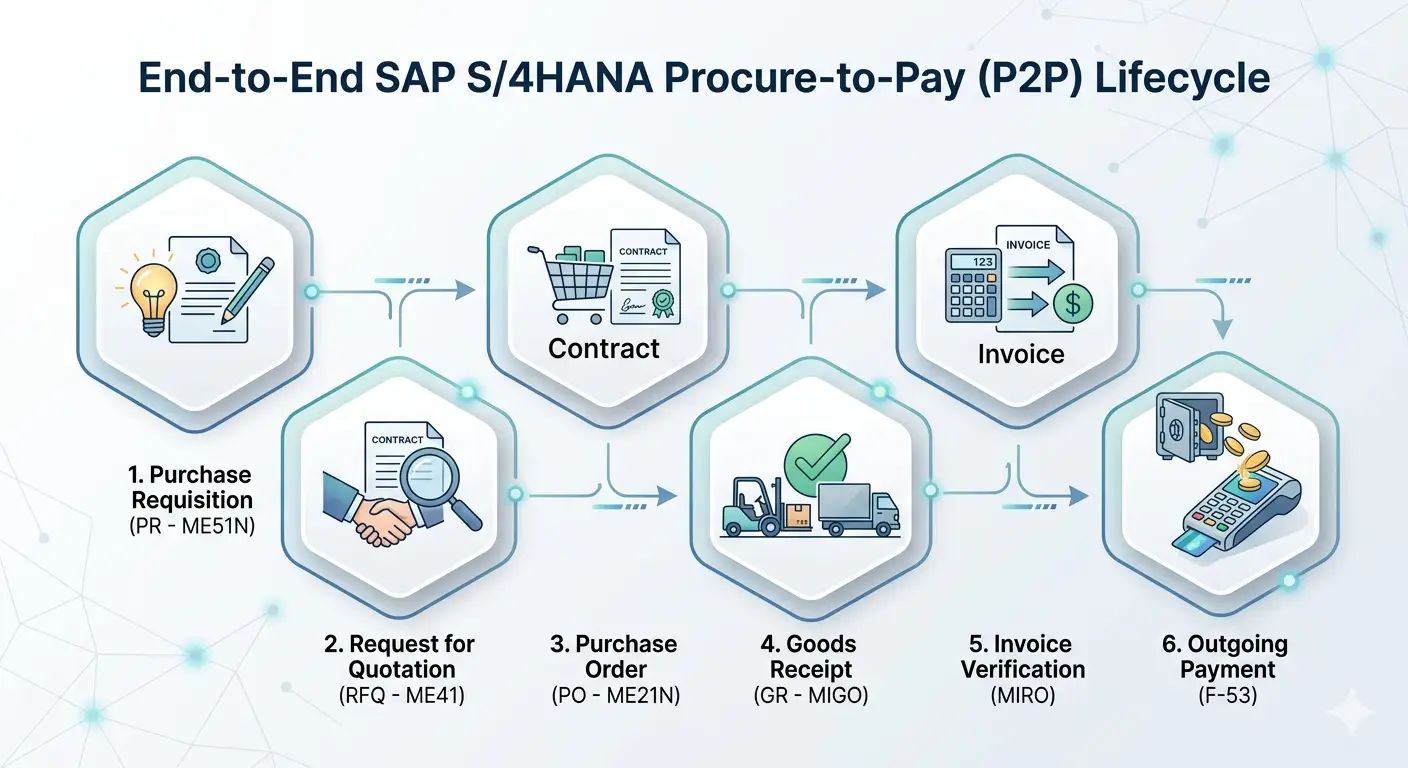
The P2P Cycle is the most critical process you will handle during your SAP MM training. Understanding the sequence is the first step; mastering the Integration T-Codes is where the professional expertise lies.
-
The Standard P2P Process Flow
| Step | Process Action | Key T-Code | Technical Intern Task |
|---|---|---|---|
| 1 | Purchase Requisition | ME51N | Internal requirement gathering and validation. |
| 2 | Request for Quotation | ME41 | Inviting and comparing vendor bids (Price Comparison). |
| 3 | Purchase Order (PO) | ME21N | Creating the external legal contract with the vendor. |
| 4 | Goods Receipt (GR) | MIGO | Updating inventory levels (Stock Increase) via Mvt Type 101. |
| 5 | Invoice Verification | MIRO | Executing the Three-Way Match (PO vs. GR vs. Invoice). |
| 6 | Outgoing Payment | F-53 | Final settlement (MM-FI Integration point). |
Expert Insight: In 2026, many of these steps are being automated via SAP Ariba. However, the core logic of the “Three-Way Match” remains the fundamental skill recruiters test for during technical rounds.

3. Mastering SAP MM Master Data: The Technical Foundation
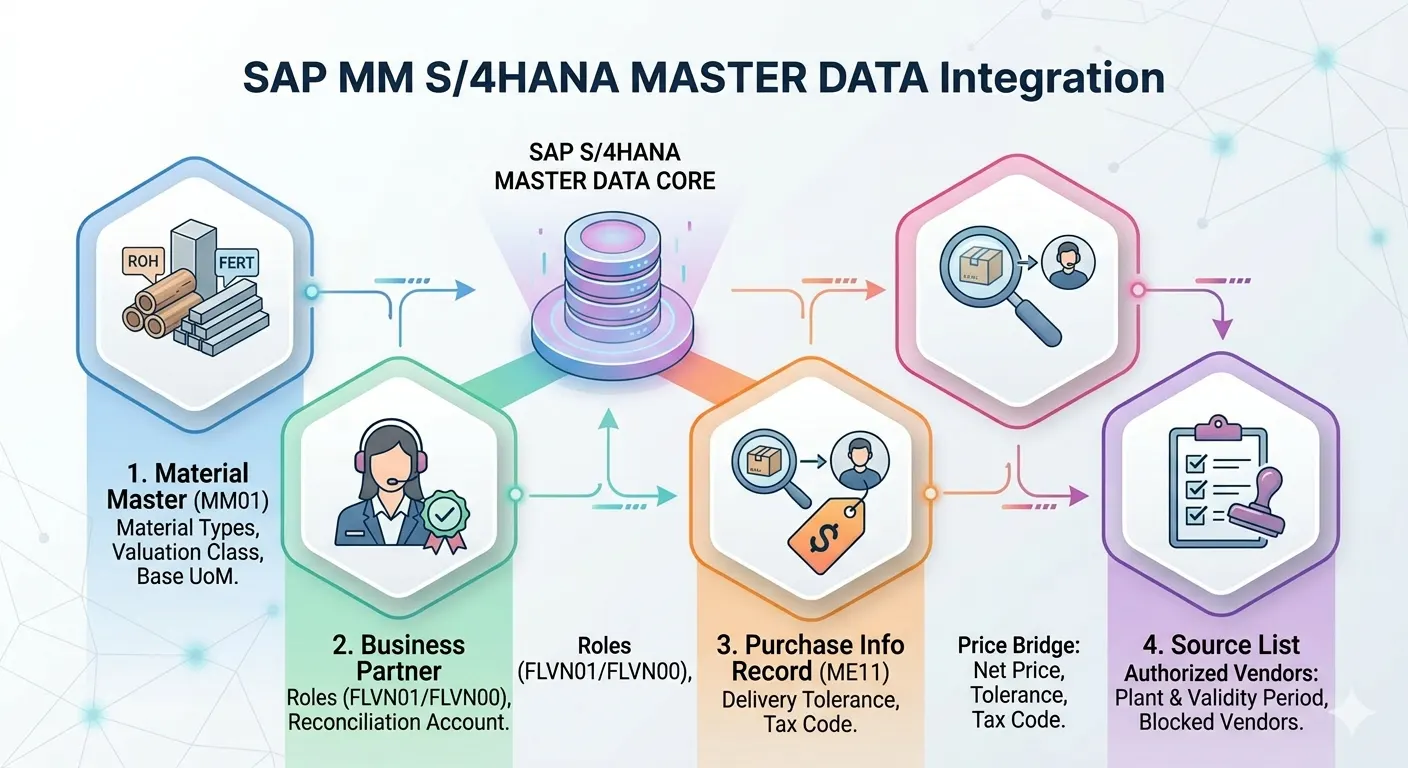
Master Data is the “Permanent Memory” of the system. If this data is configured incorrectly, every transaction will trigger a system error. During a high-quality SAP MM internship, you must master these four pillars:
I. Material Master (MM01 / MM02 / MM03)
The Material Master contains all the information needed to manage a material. It is segregated into “Views” (Purchasing, Accounting, Storage, etc.).
- Material Types: You must distinguish between ROH (Raw Materials), HALB (Semi-finished), and FERT (Finished Goods).
- Critical Field: The Valuation Class. This is the “hook” that links the material to the General Ledger (GL) in Finance.
II. Vendor Master (Business Partner in S/4HANA – BP)
In legacy SAP, we used XK01, but in SAP S/4HANA, all vendors are created as Business Partners.
- Roles: You must learn to assign roles like FLVN00 (Financial Accounting) and FLVN01 (Purchasing).
- Technical Detail: This is where you maintain the Reconciliation Account, ensuring that every purchase is correctly reflected in the company’s balance sheet.
Few related topics for your knowledge
- SAP FICO Vs SAP HANA: Which Is Better
- Analyzing The Procure To Pay Process: A Comprehensive Overview
- How SAP FICO Works In Manufacturing Industry
- SAP FICO Transaction Codes: List Of T-Codes To Remember
- Why Smart Finance Pros Are Rushing To Learn SAP FICO
- 50+ SAP MM Interview Questions and Answers Revealed
III. Purchase Info Record (PIR – ME11)
The PIR acts as the “Price Bridge.” It stores the specific relationship between a specific Vendor and a specific Material.
- Technical Insight: It allows the system to automatically suggest the last purchase price, tax codes, and delivery tolerances when you create a PO.
IV. Source List (ME01)
The Source List is a control mechanism. It defines which vendors are “authorized” to supply a specific material for a specific plant during a certain timeframe. Mastering this is vital for automated procurement and vendor management.
4. The 180-Day SAP MM Internship Success Roadmap
This structured “Sprint Plan” is the exact roadmap used by top-tier SAP MM training institutes to turn freshers into job-ready consultants in just five weeks.
| Month | Focus Phase | Key Technical Tasks & T-Codes | Success Milestone |
|---|---|---|---|
| Month 1 | Foundation & Landscape | Define Enterprise Structure: Client, Company Code, Plant, and Storage Loc. Master Navigation & SAP Fiori Basics. | Completion of a customised Business Landscape in the Sandbox. |
| Month 2 | Master Data Mastery | Extensive configuration of Material Master (MM01), Business Partner (BP), and Info Records (ME11). | Seamless data migration simulation using LTMC/LSMW. |
| Month 3 | Core P2P & Pricing | Deep dive into Procure-to-Pay (ME21N, MIGO, MIRO) and Condition Technique (Pricing Procedures). | Successful execution of a complex Price Determination scenario. |
| Month 4 | Specialized Procurement | Configuration of Subcontracting, Consignment, Third-party Procurement, and Service POs. | Handling diverse business models within the SAP MM framework. |
| Month 5 | Cross-Module Integration | Mastering MM-FI Integration (OBYC) and MM-SD/PP touchpoints. Automatic Account Determination. | Resolving complex Integration Errors and “Account Determination” issues. |
| Month 6 | Project Lifecycle & Career | User Acceptance Testing (UAT), Business Blueprinting, Resume SEO, and Mock Technical Rounds. | Final Capstone Project submission and Placement-ready Portfolio. |
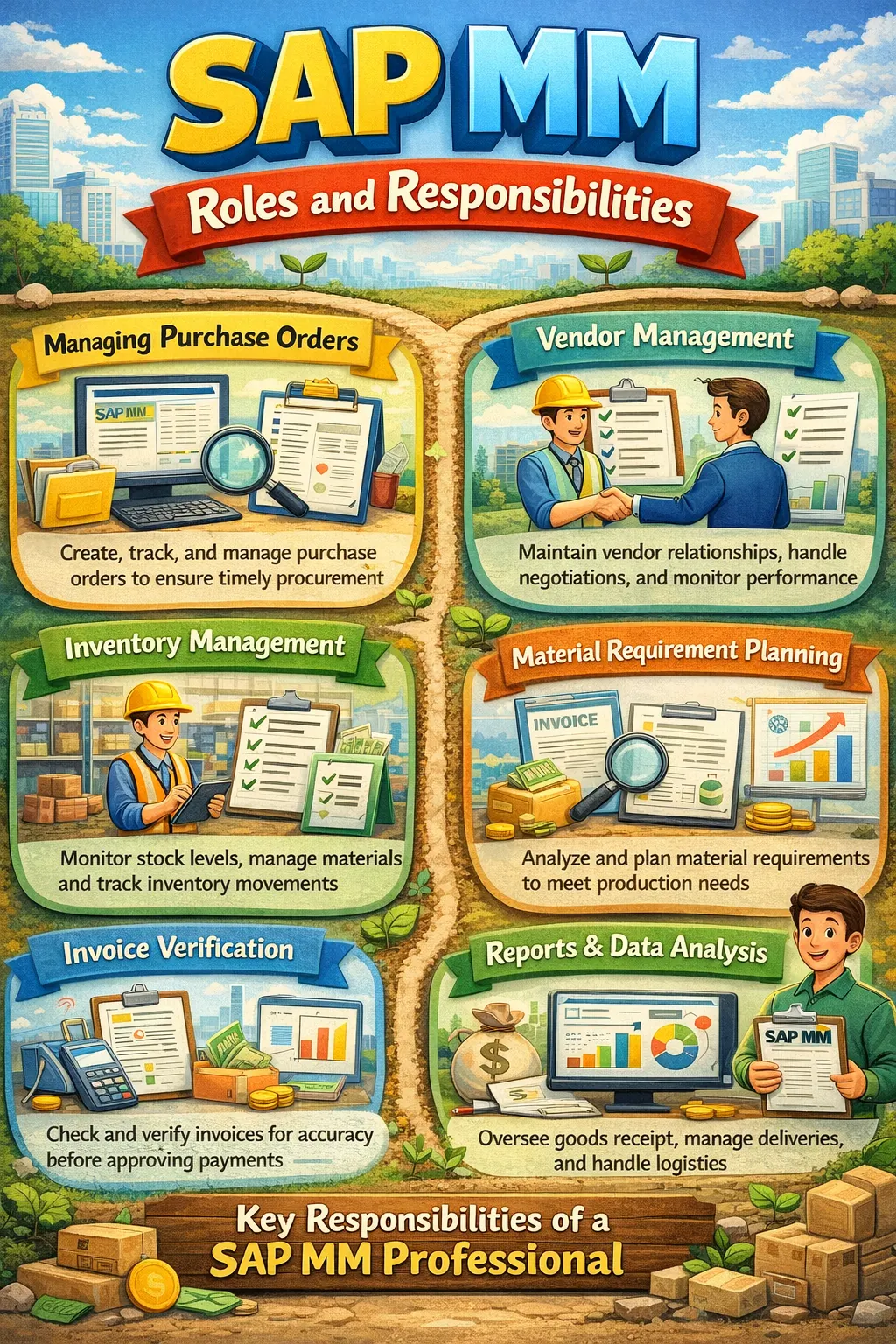
5. SAP MM Roles and Responsibilities: End-User vs Consultant
One of the biggest points of confusion for freshers is the difference between operational and strategic roles. Knowing this distinction is critical for your SAP MM functional consultant career growth.
| Responsibility Area | SAP MM End-User (Operational) | SAP MM Functional Consultant (Strategic) |
|---|---|---|
| Daily Tasks | Creating POs, Goods Receipts, Invoicing. | Business Mapping, System Configuration, Troubleshooting. |
| Skill Depth | Transactional (Knowing how to use the tool). | Architectural (Knowing why and how to build it). |
| Salary Potential | Moderate (Steady growth). | High (Exponential growth). |
| Entry Point | Direct entry for freshers. | Requires Internship + Implementation training. |
6. SAP MM Salary Trends in India (2026)
Salary is directly proportional to the quality of your practical exposure. In 2026, the SAP MM fresher salary is seeing a 15–20% premium for those with S/4HANA skills.
- Standard Graduate (No Internship): ₹2.5 – ₹3.5 LPA
- Trained Fresher (With Internship): ₹4.5 – ₹6.5 LPA
- Tier-1 City (Bangalore/Pune/Mumbai): 15-20% higher than the national average.

SAP Intern Monthly Stipend:
- Small/Mid-tier Firms: INR 8,000 – INR 15,000
- Corporate-backed Institutes/MNCs: INR 15,000 – INR 25,000+
7. How to Get an SAP MM Job Without Experience
This is the most searched question by graduates. The “Secret Sauce” is reducing the recruiter’s risk through documented proof of skill.
- Step 1: Complete a Hands-on Course. Focus on S/4HANA rather than just legacy ECC systems.
- Step 2: Secure an SAP MM Internship. This acts as your primary “Experience” substitute on your resume.
- Step 3: Optimize Your Digital Presence. Use keywords like “Material Master,” “P2P Configuration,” and “Gap Analysis” on your LinkedIn profile.
- Step 4: Build a Project Portfolio. Document your sandbox configurations with screenshots and “Business Blueprints” to show during interviews.
8. Conclusion: Strategic Career Execution
The SAP MM internship for freshers is not just a training add-on. It is a strategic employability accelerator. Certification teaches you the theory; an internship builds your credibility. In the world of SAP, Execution is the only currency that matters.
If you want a career that offers a high ceiling, global mobility, and recession-proof stability, mastering SAP MM is your best move in 2026.
9. Frequently Asked Questions
1: Is an SAP MM internship in Pune or Bangalore better?
Both are major hubs. Pune leads in Manufacturing and Automotive SAP roles (e.g., Tata Motors, Mercedes-Benz), while Bangalore dominates IT Consulting and Global Delivery Centres.
2: What is the career path after being an SAP MM Consultant?
You start as a Junior Consultant, move to Senior Consultant (4-6 years), and eventually become a Solution Architect or Project Manager, where salaries often exceed ₹25 LPA.
3: Can I learn SAP MM online?
Yes, but for freshers, a hybrid model (Online theory + Offline lab/internship) is recommended. The networking and lab access provided by a physical SAP MM training institute often lead to much faster placement.

- Data Science Course with Placement: Is It Worth It or Just Marketing? - October 9, 2026
- What is ITC in GST: The Complete Guide You Need - September 26, 2026
- SAP PP Cycle Explained: The Guide Every Fresher Should Read Before Choosing SAP - September 18, 2026