Which is Best: BBA or Accounting and Finance?
Choosing the right undergraduate degree is a pivotal decision for your career. If you are weighing your options between a Bachelor of Business Administration (BBA) and a degree in Accounting and Finance, you are likely looking for the best path to financial success. The direct answer to "which is best" depends on your career goals:
- Choose BBA if you want a broad understanding of business, leadership, and management.
- Choose Accounting and Finance if you prefer a specialized, technical role focused on managing money, taxes, and audits.

Understanding the Core Differences
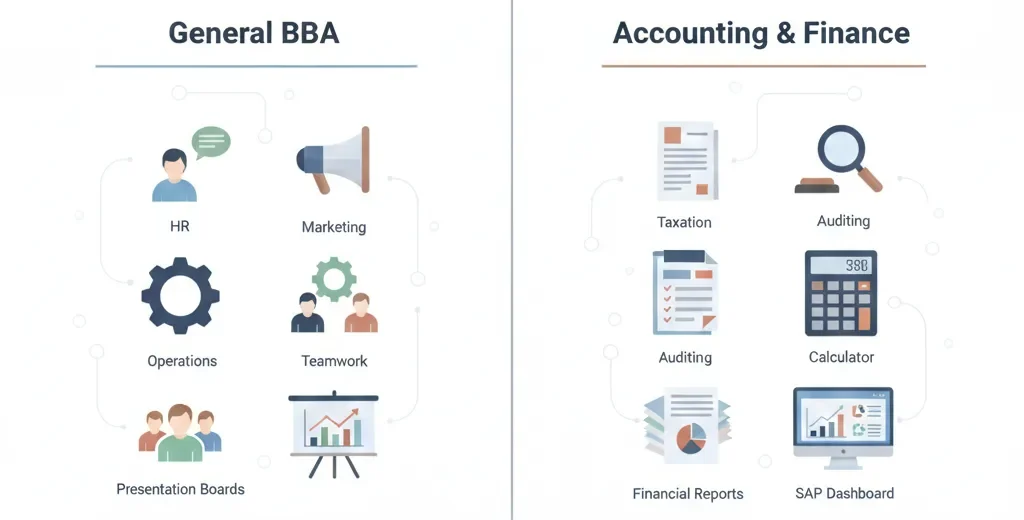
The difference between BBA and BBA Finance and Accounting lies in the scope of study. A general BBA offers a bird's-eye view of how a company functions. You will study HR, marketing, and operations alongside basic finance. In contrast, a BBA in Finance and Accounting is a deep dive. It focuses on the "nitty-gritty" of numbers. You will master Tally, GST, and corporate laws. While a general BBA makes you a "jack of all trades," the specialized version makes you a master of the balance sheet. 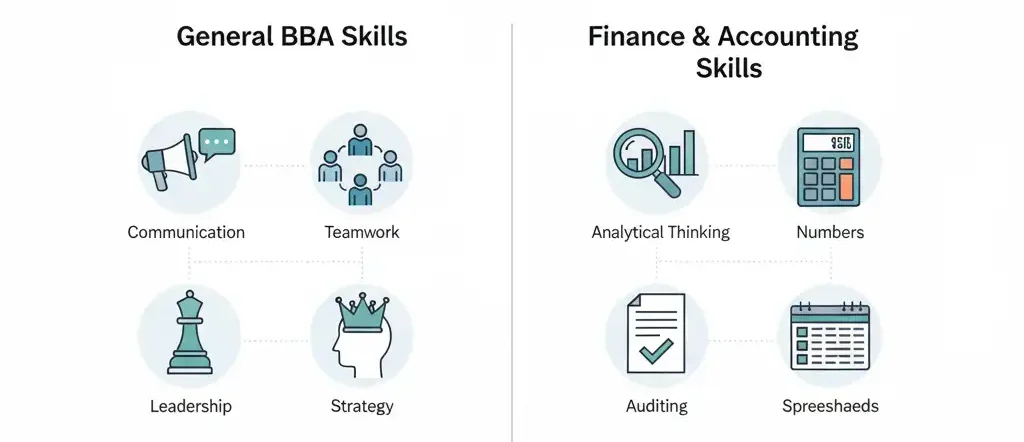
Get a BBA Degree with Paid Internship1-year paid internship + 10 Simulation Software + 4 Certifications to land high-paying roles |
|
| BBA in Accounting and Finance |
Comparison at a Glance
| Feature | General BBA | BBA in Finance & Accounting |
|---|---|---|
| Primary Focus | General Management | Financial Technicalities |
| Key Subjects | HR, Marketing, Strategy | Taxation, Auditing, SAP |
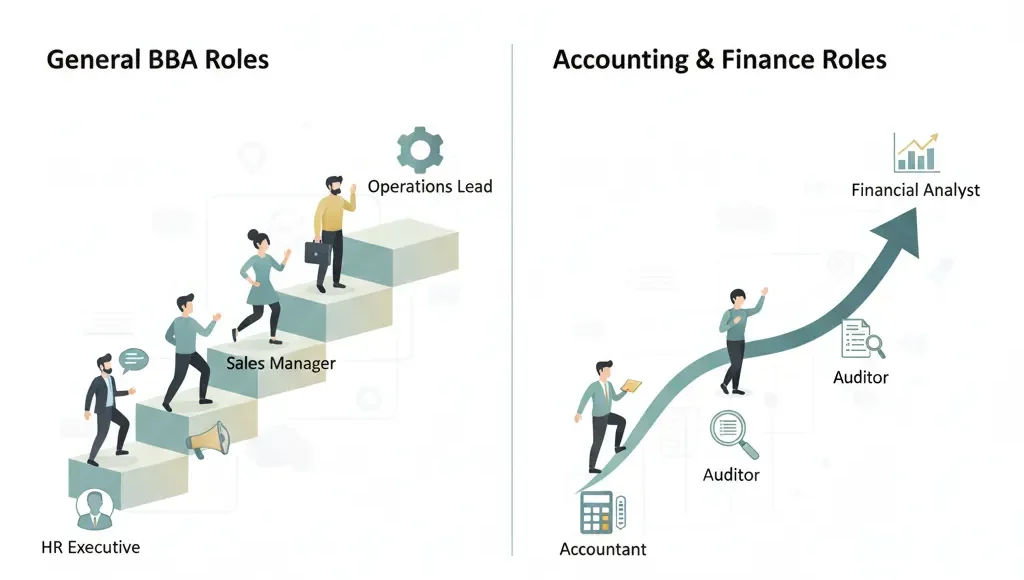
| Career Path | Operations, Sales, HR | Analyst, Auditor, Accountant |
| Skill Set | Leadership & Soft Skills | Mathematical & Analytical |
Career Prospects and Salary
Both paths lead to high-paying jobs, but the nature of the work differs. Finance professionals often find stability in specialized roles. General BBA graduates often move into diverse leadership or entrepreneurial positions.
Pros and Cons
- BBA General:
- Pros: High flexibility; prepares you for an MBA.
- Cons: Might require additional certifications for technical roles.
- BBA Finance & Accounting:
- Pros: Industry-ready from day one; high demand in every sector.
- Cons: Can be mathematically intensive.
The Best of Both Worlds: Online BBA by ICA Edu Skills and Shobhit University
If you cannot decide between the two, there is a modern solution. The Online BBA in Finance and Accounts offered by ICA Edu Skills and Shobhit University combines academic prestige with practical skills. This program is unique because it uses a "2+1" model. For the first two years, you learn online while getting hands-on training in tools like SAP, TallyPrime, and GST. In the third year, you participate in a one-year paid internship. This ensures you graduate not just with a degree, but with professional experience.
Conclusion
Ultimately, the "best" degree is the one that aligns with your passion. If you love leading teams, go for a BBA. If you love solving financial puzzles, Accounting and Finance is for you. However, if you want the technical edge of finance without sacrificing the leadership foundation of business, the BBA in Finance and Accounting by ICA Edu Skills and Shobhit University offers the perfect middle ground. It bridges the gap between theory and industry-ready skills, ensuring you’re prepared for the boardroom and the balance sheet alike. 
Frequently Asked Questions
1. Can I do an MBA after a BBA in Finance and Accounting?
Yes, absolutely. A specialized BBA is a recognized undergraduate degree. It provides an excellent foundation for an MBA in Finance or even a general MBA.
2. Which degree has a higher starting salary?
Generally, BBA Finance and Accounting graduates command slightly higher starting salaries because they possess technical skills like taxation and auditing that are immediately usable by employers.
3. Is the online BBA from Shobhit University valid for government jobs?
Yes. Since Shobhit University is UGC-DEB approved, the online degree is legally equivalent to a regular campus degree and is valid for all government exams and jobs.