The Path to Becoming a CFO Before Age 40
In the modern high-stakes economy, the Chief Financial Officer (CFO) has evolved far beyond a "numbers cruncher." You are no longer just the person who keeps the books; you are the strategic co-pilot to the CEO. If you’re aiming to hit that milestone before your 40th birthday, you aren’t just racing against time; you’re dismantling the traditional "25-year climb." Achieving this requires a radical shift in mindset, moving away from learning what to do and mastering how every financial lever impacts the billion-dollar big picture. 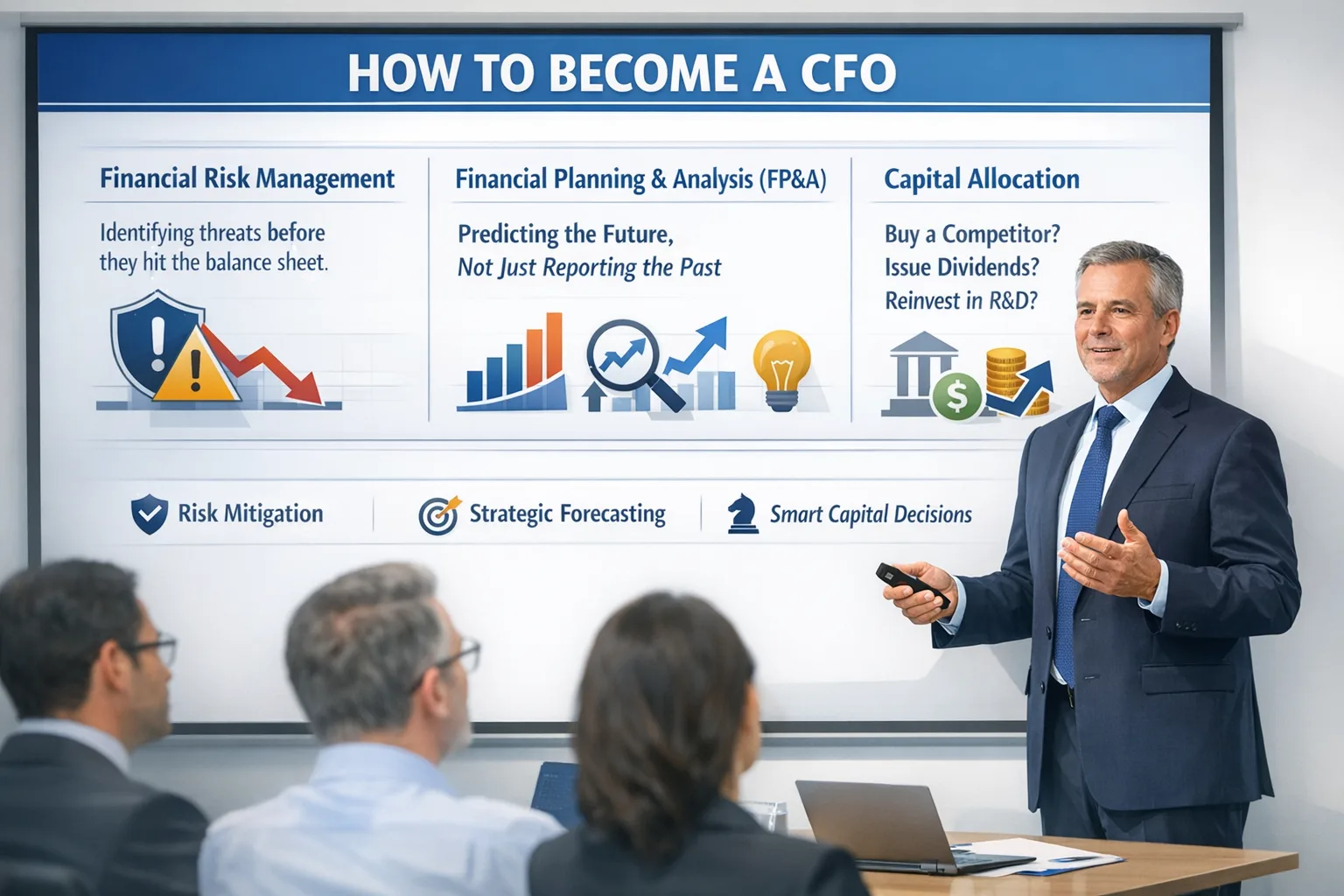
1. The Foundation: CFO Qualifications and Eligibility
You can’t build a skyscraper on a swamp. To even be in the conversation for CFO eligibility, your academic and professional baseline must be rock solid. While an MBA from a top-tier school or a CA/CPA designation is the "entry ticket," the modern market demands more.
Essential Credentials for the Modern CFO
- Professional Certifications: CA (ICAI), ACCA, or CPA remain the gold standard for understanding internal financial controls.
- Post-Graduate Edge: An MBA in Finance from an elite institution provides the networking and "big picture" strategy often missing from purely technical roles.
- Tech Stack Proficiency: Mastery of financial data analytics tools and ERP systems like SAP (FICO/S/4HANA) is non-negotiable.
2. The Secret Sauce: 90% Practice, 10% Theory
Knowing the theory of financial strategy management won't help you when a liquidity crisis hits at 2 AM. Expertise isn't born in a library; it’s forged in simulation. To accelerate your cfo career path, you must prioritise practical training from day one. This is where learning modules like the CIA Plus Program change the game. Instead of passive learning, you are immersed in a curriculum designed for the elite.
Things to keep in mind:
- Hands-On Exposure: Don't just focus on "learning" about books; rather, you must aim for mastering industry-standard simulation software and tackle live projects that mirror the high-pressure environment of a corporate finance department.
- Real-World Competence: By practising with real-world case studies, you gain the technical competence of a seasoned veteran before you even land your first full-time role.
- Paid Internship Programs: Let me be honest with you here. All your big dreams require a humble beginning. Hence, opting for a paid internship programme helps you to gain competence as well as earn money. Besides, it helps you to get acclimatised to the real-world corporate scenarios, which effectively builds a foundation for the future.
Get a BBA Degree with Paid Internship1-year paid internship + 10 Simulation Software + 4 Certifications to land high-paying roles |
|
| BBA in Accounting and Finance |
Theory vs. Real-World Execution
| Feature | Academic Learning | Practical Simulation & Internships |
|---|---|---|
| Focus | Memorising Accounting Standards | Solving real-world cash flow bottlenecks |
| Tooling | Pen, paper, and basic Excel | SAP, Power BI, and financial data analytics |
| Risk | Zero | High-stakes decision-making practice |
| Outcome | Degree/Certification | Competence and "Battle-Hardened" experience |
3. Mastering the CFO Role and Responsibilities
The cfo role and responsibilities have evolved. You are now expected to be a master of strategic financial planning. This means looking out the windshield, not just the rearview mirror.
Key Pillars of Executive Finance:
- Financial Risk Management: Identifying threats before they hit the balance sheet.
- Financial Planning and Analysis (FP&A): Moving beyond reporting history to predicting the future.
- Capital Allocation: Deciding whether to buy a competitor, issue dividends, or reinvest in R&D.
4. The 15-Year Sprint: A Chronological Roadmap
To reach the C-suite by age 40, your timeline must be compressed and intentional. Moving from a technical expert to a visionary leader requires hitting specific milestones at an accelerated pace.
The following table breaks down the cfo career path into four high-impact phases:
| Career Phase | Timeline | Primary Focus & Skill Acquisition | Key Milestone |
|---|---|---|---|
| The Sponge Phase | Years 0–3 | Secure an internship at a top-tier C.A. firm. Master the "grunt work" of audits and internal financial controls. | Practical certification (CA/CPA/ACCA) completion. |
| The Specialist Phase | Years 4–7 | Pivot into a corporate role. Deep dive into financial performance analysis and data-driven storytelling. | Promotion to Finance Manager or FP&A Lead. |
| The Strategist Phase | Years 8–12 | Transition to a Controller or VP of Finance role. Master financial strategy management and start advising the board. | Leading a major M&A or digital transformation project. |
| The Leap | Years 13–15 | Target mid-market companies or high-growth startups as their CFO to build a "proven" track record. | Appointment as CFO of a growth-stage or listed entity. |
5. Navigating the Pay Scale: CFO Salary in India
Let’s talk money. The cfo salary in india is highly variable, influenced by industry, company size, and your ability to drive growth.
Estimated Annual Compensation (INR)
- Startup/SME CFO: 40 Lakhs – 80 Lakhs + Equity.
- Mid-Sized Corporate: 80 Lakhs – 1.5 Crores.
- MNC/Large Conglomerate: 2 Crores – 5 Crores+ (excluding bonuses/LTI).
6. Fast-Track to CFO: Why Pursuing a BBA In Finance and Accounting Stands Out?
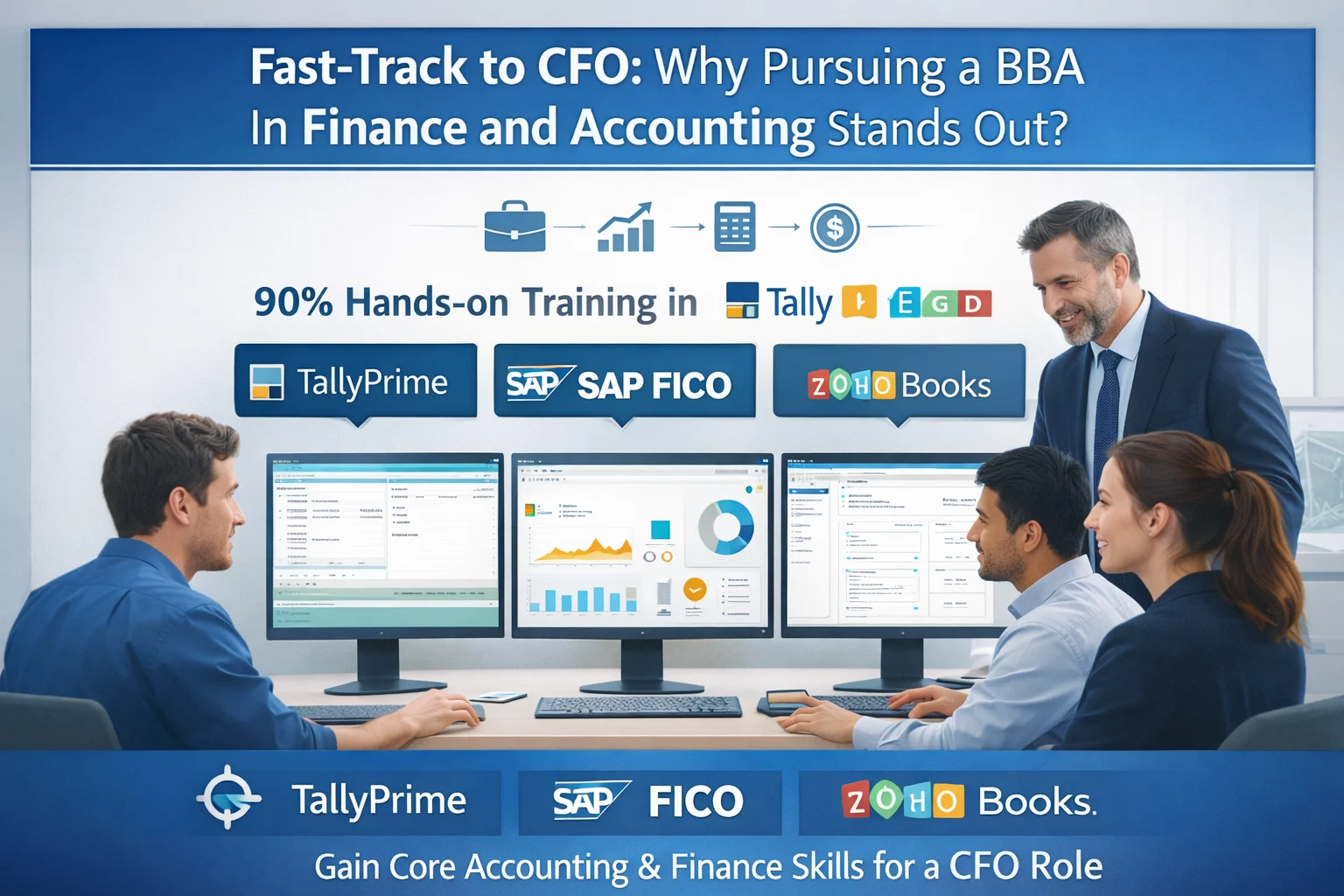
Aiming to become a CFO by 40? Build the right base with ICA Edu Skills and Shobhit University's BBA in Finance and Accounting. It delivers 90% hands-on training in TallyPrime, SAP FICO, and Zoho Books. Key perk: a paid one-year internship at CA firms or corporates. Graduate as a pro with experience and certifications, speeding your path to top finance roles.
Final Thoughts
To successfully navigate the high-stakes journey from a BBA graduate to a Chief Financial Officer, your strategy must evolve beyond the classroom. Particularly, a BBA in Finance and Accounting can accelerate your chance to be a CFO. The market is increasingly crowded with generalists, but it is starving for specialists who can bridge the gap between financial theory and boardroom execution.
Key Takeaways
- Practice is King: Shift from 100% theory to 90% practical simulation as early as possible.
- Early Exposure: Use internships at C.A. firms to build technical muscle.
- Strategic Mindset: Focus on strategic financial planning rather than just keeping the books balanced.
- Tech Mastery: Be the person who understands data better than the IT department.

Frequently Asked Questions
1. Is an MBA mandatory to become a CFO?
While not legally mandatory like a CA or CPA might be for certain roles, an MBA is often the catalyst for shifting from a "technical" finance role to a "strategic" executive role. It bridges the gap between accounting and leadership.
2. How important is 'Practical Training' compared to a degree?
A degree gets you the interview; practical expertise gets you the job. Using simulation software and handling real case studies during your training phase prepares you for the volatility of the real market, which theory alone cannot do.
3. What is the most critical skill for a 2026 CFO?
Beyond financial literacy, the most critical skill is Financial Data Analytics. Being able to translate complex data sets into actionable business stories is what separates a Controller from a CFO.
4. Can I become a CFO without working at a Big 4 firm?
Absolutely. While Big 4 experience is prestigious, working at reputed mid-sized C.A. firms often provides more "hands-on" experience across all financial operations, which can be more beneficial for a well-rounded CFO career path.