A Semester-by-Semester Guide to What Actually Happens in an Online BBA
You've probably heard both sides. "An online degree isn't a real degree." "You'll just watch some videos and get a certificate nobody respects." Or the opposite: "Online BBA, get a degree without doing anything!" Here's the truth: neither version tells you what actually happens, semester by semester, once you enrol. And if you're a 12th-pass student trying to decide what to do next, that gap between rumour and reality is exactly where bad decisions get made. So let's fix that. No vague promises, no marketing fluff just a real, semester-wise walkthrough of what an online BBA looks like on the inside, using the actual structure of the BBA in Finance and Accounting program to show you what's really being taught, tested, and built into your resume along the way.
The Real Question Isn't "Online or Offline"; It's "What Am I Actually Learning?"
Think about your cousin, or a senior from school, who's doing a "regular" BBA right now. Ask them what they did last semester. Most will say something like: "We had Principles of Management, wrote some assignments, gave exams." Now ask: Did you file a GST return? Did you close a set of books in Tally? Do you know what an SAP screen looks like? Silence. That's not a dig at traditional BBA students; it's a structural problem. A lot of degree programs are built to test what you can write in an exam hall, not what you can do in front of a client or a spreadsheet. A well-designed online BBA, on the other hand, can be built the opposite way around: software, simulations, and a live internship running alongside your syllabus. That's exactly what's happening in the BBA in Finance and Accounting offered through ICA Edu Skills' partnership with Shobhit University, a NAAC 'A'-accredited university, with the degree recognised by UGC-DEB and approved by AICTE. So it counts for government exams, higher studies, and job applications like any other BBA, while the actual coursework looks nothing like a "regular" one. Let's walk through it, semester by semester.
Get a BBA Degree with Paid Internship1-year paid internship + 10 Simulation Software + 4 Certifications to land high-paying roles |
|
| BBA in Accounting and Finance |
Semester 1: Learning the Language of Business
Your first six months aren't spent memorising theory in isolation; they're spent learning how a business actually records and communicates.
- Business Computer Applications: the digital basics every workplace expects you to already know
- Financial Accounting: the foundation everything else in finance is built on
- TallyPrime: India's most widely used accounting software, taught hands-on
- Business Communication: emails, presentations, and professional conversations that don't sound like a school essay
- Virtual Office & Live Project: your first taste of simulated workplace tasks
By the end of Semester 1, you're not just "aware" of accounting; you can actually open Tally and post an entry. That's a small thing on paper and a big thing in an interview.
Semester 2: Where Most Students Start Feeling the Difference
This is the semester where the "online BBA is easy" myth usually falls apart, because the subject list gets serious fast:
- Advanced MS Excel: VLOOKUP, pivot tables, and the formulas that separate "knows Excel" from "actually useful in Excel"
- Accounts Finalisation & Ratio Analysis: reading a balance sheet like a professional, not a textbook
- Direct Tax with Simulation: practising real tax filing scenarios, not just reading Income Tax slabs
- GST with Simulation: actual GST return filing practice
- AI Tools in Accounts & Finance because the finance job of 2026 already expects you to know how AI fits into the workflow
If Semester 1 was the alphabet, Semester 2 is where you start forming sentences, and employers actually notice this on a resume.
Semester 3: Stepping Into Enterprise-Level Tools
Here's where the syllabus stops feeling like "college" and starts feeling like "training for a real finance department":
- Accounting with ERP Software (Zoho Books), the kind of system mid-sized and large companies actually run on
- Banking & Auditing: understanding both sides of the table- the bank's and the auditor's
- Data Analytics Tools (Power BI): turning raw numbers into dashboards a manager can actually use
- Indian Accounting Standards (Ind AS): the compliance backbone of every audited company
- MCA Compliance (including XBRL & LLP filings): corporate filing knowledge most fresh graduates never touch until their first job forces them to
A lot of commerce graduates hear "XBRL" for the first time at their first job. Here, it's Semester 3. 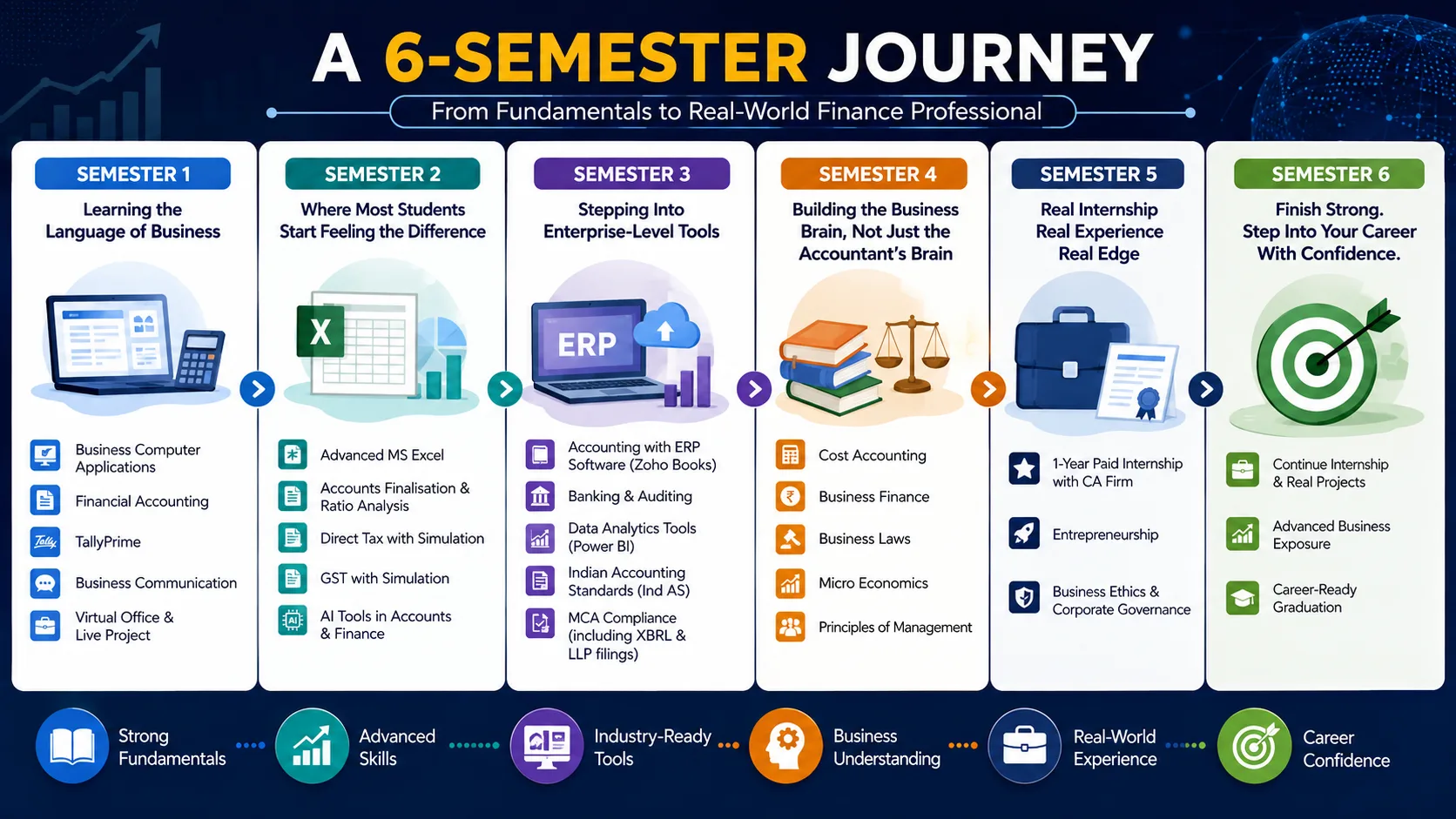
Semester 4: Building the Business Brain, Not Just the Accountant's Brain
Finance doesn't happen in a vacuum; it happens inside a company, inside laws, inside an economy. Semester 4 widens the lens:
- Cost Accounting
- Business Finance
- Business Laws
- Micro Economics
- Principles of Management
This is the semester that makes you promotable later because the person who understands why a decision makes financial sense, not just how to record it, is the one who eventually manages the team.
Semester 5 & 6: The Part Most Degrees Don't Have A Real Internship
This is genuinely the biggest structural difference. In most BBA programs, "internship" means a two-month formality squeezed in during summer, usually arranged by the student themselves, often unpaid, and rarely relevant. Here, after the first six months of coursework, students can apply for a 1-year paid internship, working with a CA firm, alongside subjects like:
- Entrepreneurship
- Business Ethics & Corporate Governance
So while you're finishing Semester 5 and 6, writing exams, submitting projects, you're also earning a stipend, building a work history, and collecting a CA-firm internship certificate before you've even graduated. Picture two students on the same graduation day. One has a degree and a two-line "internship" no one asks about. The other has a degree, a year of paid work experience, four certifications, and answers to give when an interviewer asks, "So tell me about a real project you've worked on." That gap is what these final semesters are quietly building.
What You Actually Walk Away With
By the time you finish all six semesters, the paper in your hand isn't just a BBA certificate. It comes packaged with:
- ICA + NSDC Certificate: proof of nationally recognised skill training
- ZOHO Training Shop Certificate
- SAP FICO Certificate (through ICA's official SAP partnership)
- Internship Certificate from a CA firm
Four credentials, one degree, three years instead of one credential and a lot of "I'm a fast learner" in your interview answers. 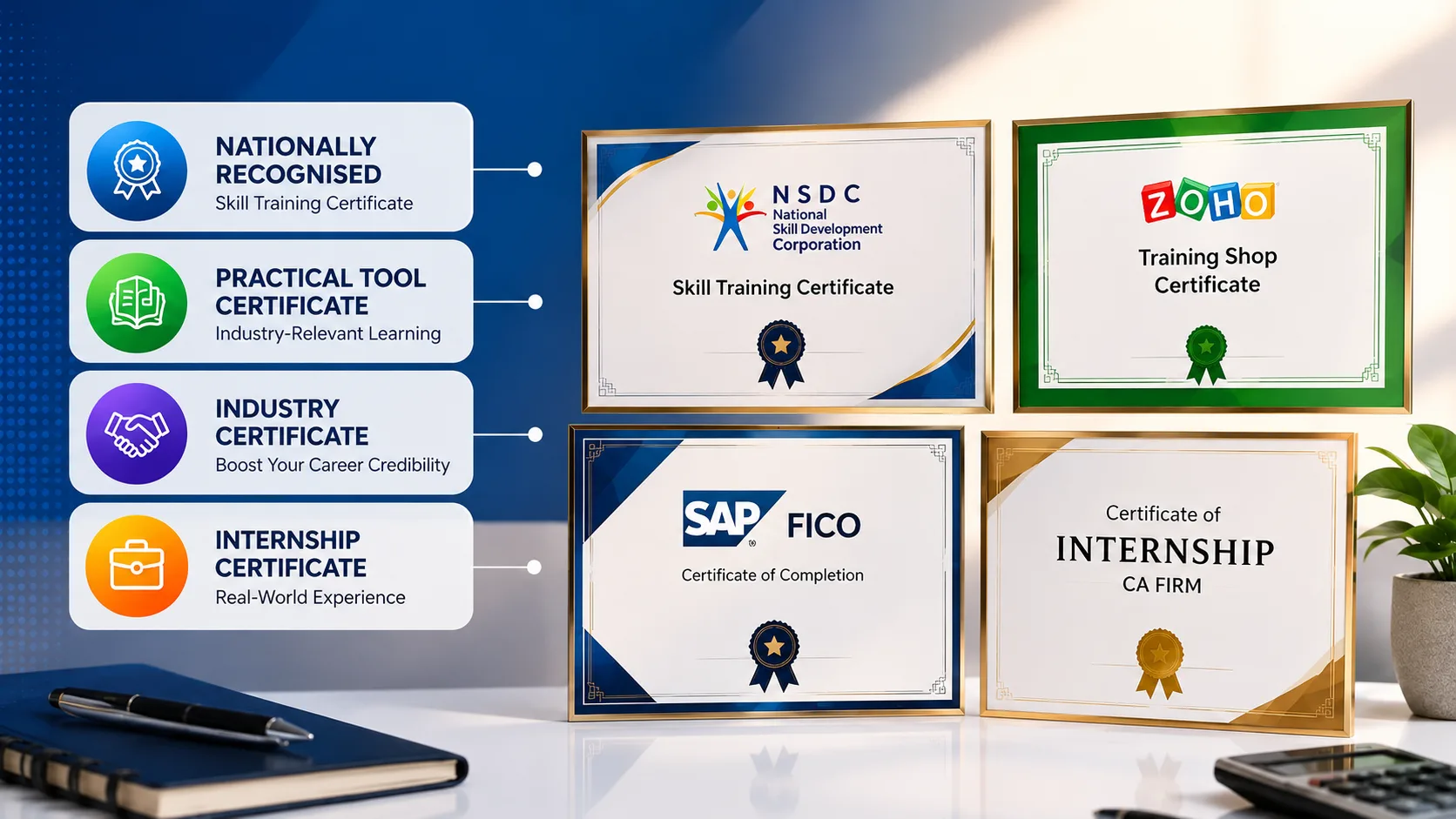
"But Is It Actually Valid?" Addressing the Fear Directly
This is the question every parent asks, and every student is too embarrassed to ask out loud. So let's answer it directly: the BBA in Finance and Accounting is offered through Shobhit University, is recognised by UGC-DEB, and is approved by AICTE. That means it's valid for government job applications, competitive exams, and further studies in India and abroad, exactly like a degree from a physical campus. What differs isn't the paperwork. It's what you actually did to earn it.
Traditional BBA vs. This Work-Integrated BBA
| Parameter | Traditional BBA (most colleges) | Online BBA in Finance & Accounting |
|---|---|---|
| Tools taught | 1–2, mostly theoretical | 15+ tools, including 6 AI tools |
| Internship | Self-arranged, usually 2 months, often unpaid | 1-year internship with stipend, built into the program |
| Certifications | Degree only | Degree + 4 industry certifications |
| Software training | Rare or optional | TallyPrime, SAP, Zoho Books, Power BI, GST/ITR simulations |
| Exit flexibility | Fixed 3-year commitment | Multiple entry & exit with credit-backed exit qualifications |
Career Doubts Students Actually Have
"I'm not from a Commerce background; can I even survive this?" Yes. The program starts from foundational business and accounting concepts in Semester 1 specifically because it's built for students from any stream, not just Commerce toppers. "Will companies actually hire someone with an online degree?" Recruiters like Accenture, IBM, TCS, and HDFC Bank hire graduates from this program, and an online BBA graduate who's already worked a paid internship often walks into interviews with more real experience than a campus student who hasn't. "What if I can't afford it in one shot?" There's a semester-wise payment option and a 0% interest loan facility, so the fee doesn't have to be one intimidating lump sum.
The Bottom Line
An online BBA isn't automatically "less than" a campus degree, and it isn't automatically better either. What actually matters is what's happening inside each semester: whether you're learning to operate real software, whether there's a genuine internship attached, and whether the certificate on your wall is backed by something you can actually demonstrate in an interview. If you've read this far because you're staring at a 12th-mark sheet and wondering what comes next, that's exactly the decision point this guide was written for. A BBA in Finance and Accounting built around live tools, a paid internship, and four stacked certifications gives you something a lecture-only degree can't: proof, not just a promise, that you're ready to work. 
Frequently Asked Questions
1. Is an online BBA in Finance and Accounting as valuable as a regular BBA?
Yes, as long as it's from a UGC-DEB recognised and AICTE-approved university. The BBA in Finance and Accounting through Shobhit University carries the same academic validity as a campus degree, while adding practical software training and a paid internship that most traditional BBA programs don't offer.
2. Do I need a Commerce background to join this BBA program?
No. The course is designed for students from any stream after Class 12, starting with foundational subjects like Financial Accounting and Business Communication in Semester 1 before moving into advanced topics like GST, taxation, and ERP software.
3. How does the 1-year paid internship actually work during the BBA?
After completing six months of coursework, students can apply for a 1-year internship with a CA firm, earning a stipend while continuing their Semester 5 and 6 coursework, so you graduate with both a degree and a year of real, certified work experience already on your resume.