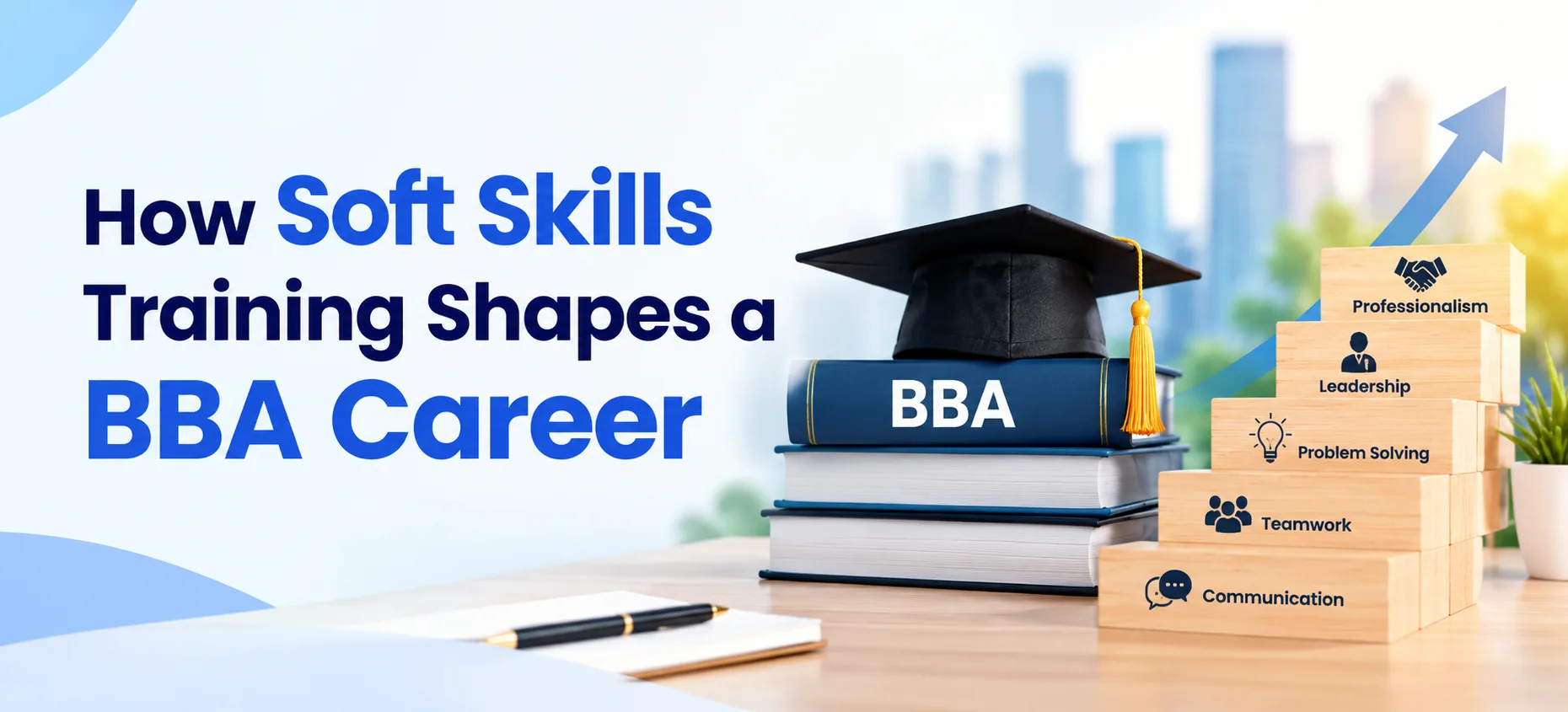
How Soft Skills Training Shapes a BBA Career
You've topped your commerce class. You can explain double-entry bookkeeping in your sleep. But in your first interview, when the panel asks, "Tell us about yourself," you freeze. Three rejections later, the truth sinks in: nobody was testing your textbook knowledge. They were testing whether you could think on your feet. Sound familiar? Every year, thousands of 12th pass students start a BBA dreaming of a stable career focused entirely on grades, assuming the degree alone will do the talking. It won't.
Why Marks Alone Don't Open Doors Anymore
Recruiters aren't just scanning for CGPA anymore. They're watching how you introduce yourself, handle a tricky question, and explain a concept to someone outside finance. A BBA in Finance and Accounting gives you the technical base, but soft skills decide whether you get hired, promoted, or trusted with a client.
Get a BBA Degree with Paid Internship1-year paid internship + 10 Simulation Software + 4 Certifications to land high-paying roles |
|
| BBA in Accounting and Finance |
What Soft Skills Really Mean in a Finance Career
Forget the vague definition. In a real finance role, soft skills look like:
- Explaining a budget variance without sounding like a textbook
- Staying calm when a client questions your numbers
- Speaking up in a meeting instead of just nodding along
- Adapting when a project brief changes overnight
- Writing an email that's clear, not clumsy
That's the difference between an accountant who processes numbers and one who gets invited into strategy meetings.
How the Right BBA Builds This
Most students assume soft skills will "happen naturally" in college. They rarely do on their own. A well-structured BBA builds them into the coursework itself through group discussions, mock interviews, and real feedback.
BBA in Finance and Accounting by ICA Edu Skills and Shobhit University
This is exactly the gap the BBA in Finance and Accounting by ICA Edu Skills and Shobhit University is built to close. Instead of treating soft skills as a separate add-on, the program weaves them into every course: monthly mock interviews, group discussions to sharpen thinking under pressure, resume-building sessions, and SOBO (Speak Out Bowl Out) sessions to get students comfortable speaking up in a room. You graduate with a finance foundation and the confidence to use it.
The Bottom Line
A BBA, especially an online BBA built for flexibility, isn't just a qualification to tick off. It's about walking into your first job, or your next one if you're switching careers, able to actually perform, not just recite. If you're weighing your options, the real question isn't "what will I learn?" It's "will this program teach me to use what I learn?" 
Frequently Asked Questions
1. Is an online BBA as good as a regular BBA for building soft skills?
Yes, if it's designed well. Live group discussions and mock interviews build soft skills just as effectively online, plus you learn to communicate confidently across digital platforms.
2. I'm a career switcher with no finance background. Will soft skills training help me?
Absolutely. Interviewers often weigh how clearly you explain your transition more than technical gaps. Soft skills training helps you frame your experience in a way recruiters understand.
3. Do I need a separate soft skills course alongside my BBA?
Not if your BBA already builds it in. Choose one where communication, mock interviews, and group discussions are part of the regular coursework, not a paid add-on.