5 Mistakes New BBA Students Make and How to Avoid Them
You’ve finished your boards, the results pressure is finally fading, and you’ve decided to step into the world of business. You’ve enrolled in a BBA, thinking it’s the golden ticket to a corporate cabin and a six-figure salary. But here is the cold, hard truth: A BBA degree is only as valuable as the strategy you use to get it. Every year, thousands of students walk into business schools with big dreams but fall into the same traps that leave them struggling for placements three years later. If you want to be the person recruiters fight over, you need to avoid these five common pitfalls.
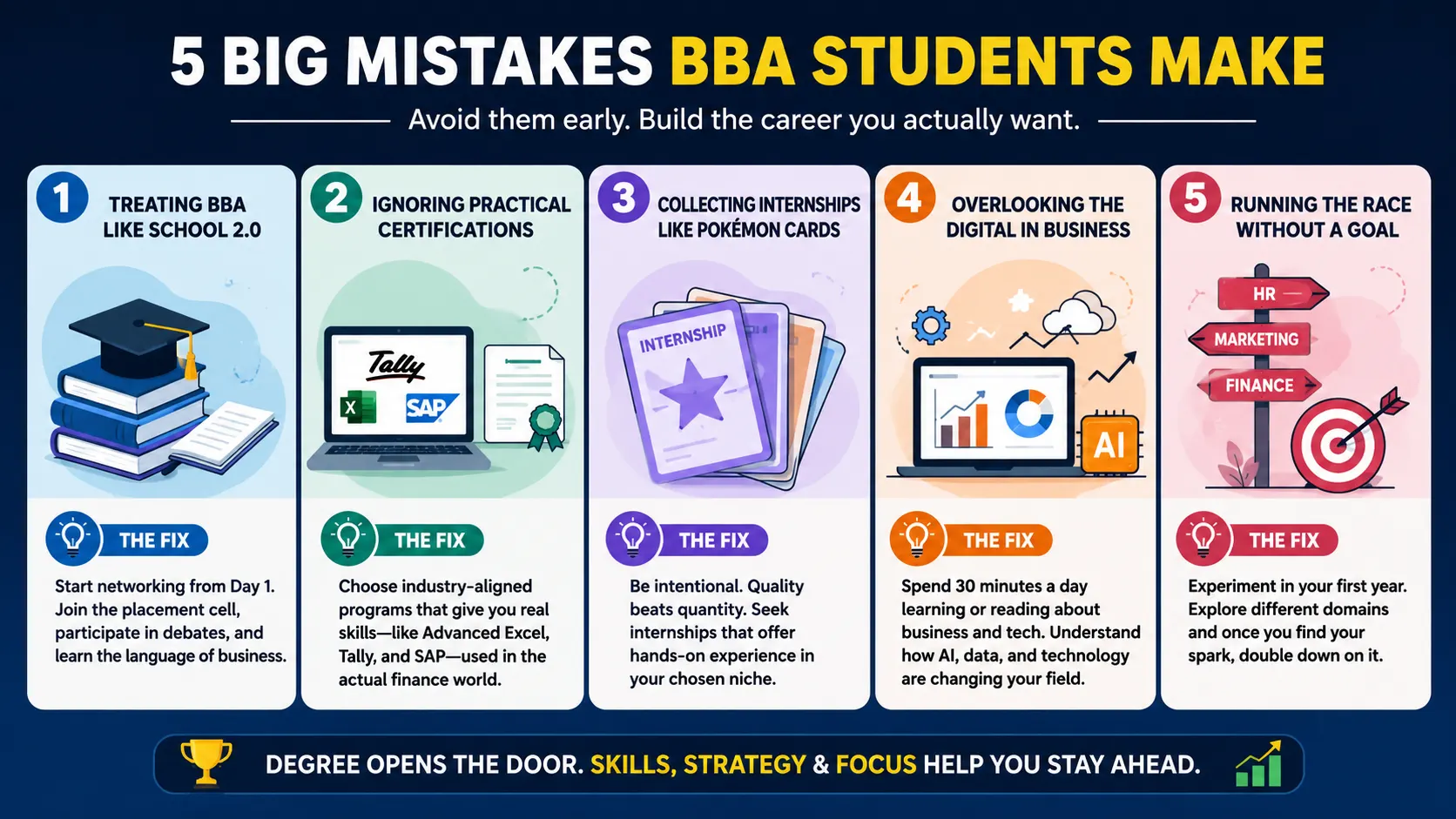
1. Treating BBA Like School 2.0
The biggest mistake is thinking that if you just attend classes and memorize the textbook, you’ll be successful. In a BBA, your GPA matters, but your soft skills matter more.
- The Fix: Start networking from Day 1. Join the placement cell, participate in debates, and learn the language of business.
2. Ignoring Practical Certifications
A degree tells an employer you can learn; a certification tells them you can work. Many students realize too late that "Introduction to Accounting" in a textbook is very different from managing GST or Tally in a real office.
- The Fix: Look for industry-aligned programs. For instance, the BBA in Finance and Accounting, offered by ICA Edu Skills and Shobhit University, is designed specifically to bridge this gap. It doesn’t just give you a degree; it equips you with the technical tools used in the actual finance industry, like Advanced Excel and SAP.
Get a BBA Degree with Paid Internship1-year paid internship + 10 Simulation Software + 4 Certifications to land high-paying roles |
|
| BBA in Accounting and Finance |
3. Collecting Internships Like Pokémon Cards
Many students take any internship just to fill their CV. If you want to go into Finance, doing a random data-entry internship won't help.
- The Fix: Be intentional. Quality beats quantity. Seek internships that offer "hands-on" experience in your chosen niche.
4. Overlooking the Digital in Business
We live in a world where AI and data drive every decision. If you aren’t learning how technology impacts marketing or finance, you’re already falling behind.
- The Fix: Spend 30 minutes a day reading business news or learning basic data visualization. Understand how tech is disrupting your field.
5. Running the Race Without a Goal
Are you doing a BBA because you love management, or because your friends are doing it? The herd mentality is the fastest way to career burnout.
- The Fix: Experiment in your first year. Explore HR, Marketing, and Finance. Once you find your spark, double down on it.
Why Choosing the Right Path Matters
If you are worried about the job market, you aren’t alone. The fear of "will I get a job?" is real. This is why specialized degrees are becoming the new standard. An online BBA or a hybrid model that focuses on high-growth sectors—like finance—can give you a massive head start. By choosing a path like the BBA in Finance and Accounting, you are essentially future-proofing your career. You aren't just learning about business; you are learning the business.
Conclusion
Your BBA years will fly by. You can either spend them just getting a degree, or you can spend them becoming a professional. Avoid these five mistakes, stay curious, and consider a specialized BBA in Finance and Accounting to ensure that when you graduate, you aren't just looking for a job, you're choosing one. 
Frequently Asked Questions
1. Is a BBA enough to get a high-paying job?
A general BBA is a foundation, but to get a high-paying role, you usually need specialized skills or certifications in areas like Finance, Data Analytics, or Digital Marketing.
2. Can I do a BBA if I’m not from a Commerce background?
Absolutely! BBA is open to students from the Science and Arts as well. The key is to quickly catch up on core concepts through practical-heavy programs.
3. What is the benefit of a BBA in Finance and Accounting over a regular BBA?
A regular BBA is broad, whereas a BBA in Finance and Accounting focuses on technical skills like taxation, auditing, and financial management, making you "job-ready" for the banking and corporate sectors immediately.