Interview Training Course: Why Skilled Candidates Still Get Rejected
Summary
An interview training course is a structured program that teaches you how to present your skills and experience clearly under pressure, usually through mock interviews, feedback sessions, body language coaching, and answer frameworks like STAR (Situation, Task, Action, Result). It closes the gap between knowing your subject and actually performing well in the room.
You know your subject. You cleared the resume screening. You even got through the technical or aptitude round without breaking a sweat. Then someone leans forward and says, “So, tell me about yourself,” and your mind goes completely blank.
If that’s ever happened to you, you’re not alone, and you’re definitely not underqualified. You just never practiced the part of the process that actually decides whether you get the offer: the interview itself.
Why Do Talented Candidates Still Lose Job Offers?
Because interviews test something colleges rarely teach: how you communicate under pressure, not just what you know.
The numbers back this up. The India Skills Report 2026 puts national graduate employability at 56.35%, up from 54.81% the year before. That’s real progress, but it still means close to half of India’s graduates aren’t considered job-ready, even with a degree in hand.
And here’s the part that surprises most people: the gap usually isn’t technical. A widely cited Leadership IQ study tracking over 20,000 new hires found that 89% of hiring failures came down to attitude and interpersonal skills. Only 11% happened because someone actually lacked the required skill. Nine out of ten people who didn’t make it past their first year weren’t rejected for what they knew; they were rejected for how they came across.
First impressions matter more than most candidates realize, too. A large-scale academic study of over 600 real job interviews (by researchers at Old Dominion, Florida State, and Clemson) found that nearly 60% of hiring decisions were made within the first 15 minutes, well before the interview officially ends. You don’t need to be perfect from minute one, but you also don’t get 45 minutes to “warm up.”
So the good news is: this is fixable. It’s not a personality flaw; it’s a practice gap.
What Is an Interview Training Course?
An interview training course is a structured program built to prepare candidates for the real, unpredictable experience of sitting across from a recruiter, not just the theory of what a “good answer” looks like.
Unlike a resume-writing workshop or a general career webinar, it usually combines:
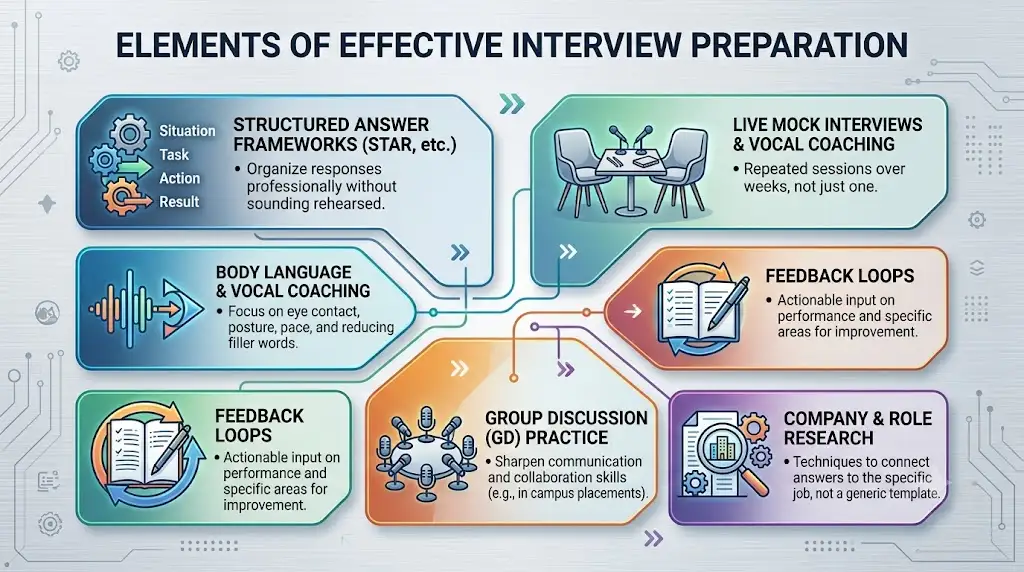
- Answer frameworks (like STAR: Situation, Task, Action, Result) to structure responses without sounding rehearsed
- Live mock interviews, ideally repeated over weeks, not a single session
- Body language and vocal coaching: eye contact, posture, pace, filler-word control
- Feedback loops, where someone actually tells you what went wrong and why
- Group discussion (GD) practice, common in campus placements and entry-level hiring in India
- Company and role research techniques, so answers connect to the actual job, not a generic template
The goal isn’t to memorize scripted answers. Recruiters can tell the difference between a rehearsed line and a confident one. The goal is repetition under realistic conditions, until nervousness stops running the show.
What Does an Interview Skills Course Actually Teach You?
Here’s where it gets practical. A decent interview skills course typically walks you through:
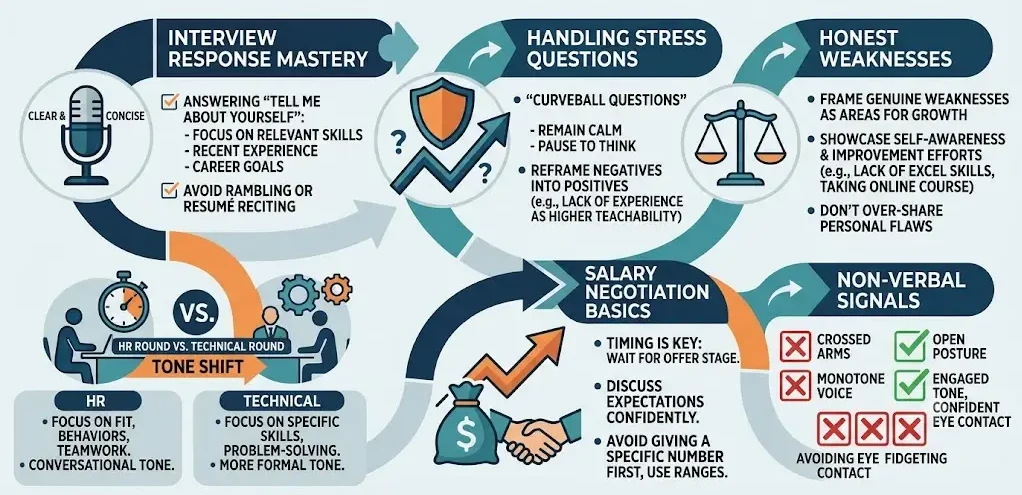
- How to answer “Tell me about yourself” without rambling or reciting your resume word for word
- How to handle curveball or stress questions (“Why should we hire you over someone more experienced?”) without freezing
- How to talk about weaknesses honestly without either underselling or oversharing
- HR round vs. technical/domain round differences and why your tone should shift between the two
- Salary negotiation basics: when to bring it up, how to phrase it, and what not to say first
- Non-verbal signals that quietly work against candidates: crossed arms, monotone delivery, avoiding eye contact, fidgeting
Most of this sounds obvious in a list. It rarely feels obvious when you’re sitting in the hot seat, which is exactly why practice matters more than reading about it.
Online Interview Coaching vs. Learning It Yourself: What Actually Works?
Plenty of candidates try to self-prep using YouTube videos, blog posts, and forums like Reddit or Quora. That’s not a bad starting point it builds awareness. But awareness and performance are two different skills.
Here’s the honest comparison:
| Factors | Self-Study | Online Interview Coaching |
|---|---|---|
| Information | Yes, plenty of it | Yes, usually curated |
| Live practice | Rarely | Core part of the program |
| Personalized feedback | No | Yes, if the program is well run |
| Accountability | Depends entirely on you | Built into the schedule |
| Learns your specific weak points | Hard to self-diagnose | That’s the whole point |
You can read a hundred articles on body language and still fold your arms defensively the moment you’re nervous, simply because no one’s pointed it out to you in the moment. That’s the real value of online interview coaching: it’s not more information; it’s a mirror with feedback attached.
Who Actually Needs an Interview Training Course?
Almost everyone benefits, but the “why” changes depending on where you’re standing.
Freshers and final-year students: You’ve never sat in a formal interview before, and the first real one you get often matters the most; campus placements don’t always offer a second attempt. Structured mock interviews and GD practice matter here more than almost anywhere else.
Career switchers: If you’re moving from, say, teaching into corporate finance, or retail into IT support, your challenge isn’t proving you’re smart; it’s explaining a career change in a way that sounds intentional instead of desperate. That’s a specific skill an interview training course can drill.
Working professionals going for a better role: You’ve interviewed before, sure, five years ago, for a very different, much lower-stakes job. Interview formats, expectations, and even the questions have shifted since then, especially with more panels now testing communication and stakeholder-handling skills alongside technical depth.
How Do You Choose the Right Interview Training Course?
Not all programs are built the same. Before you commit money or time, check for these:
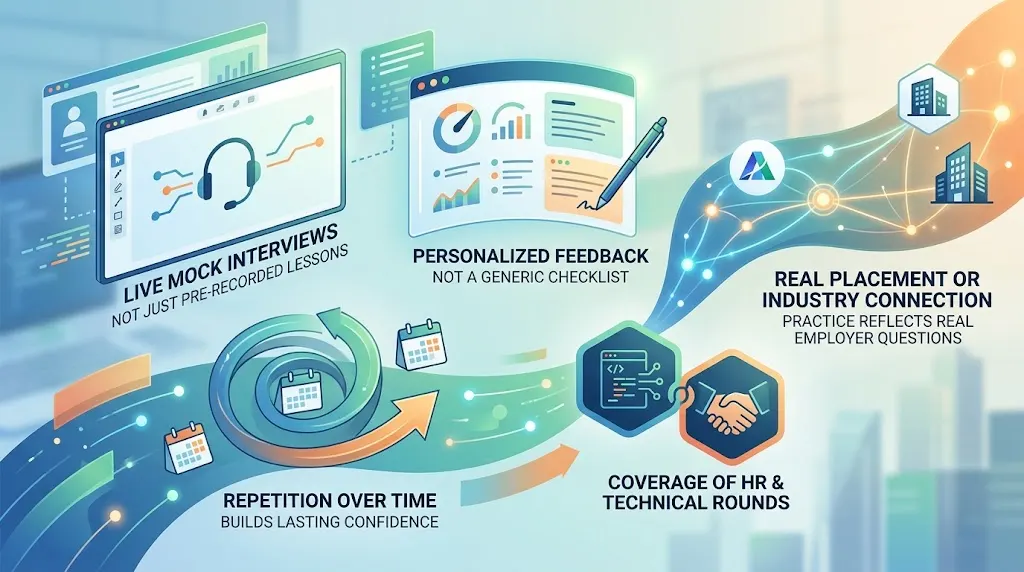
- Live mock interviews, not just pre-recorded video lessons you passively watch
- Personalized feedback, not a generic checklist applied to everyone
- Repetition over time, since one session before your interview rarely builds lasting confidence
- Coverage of both HR and technical/domain rounds, especially if you’re in a specialized field
- Real placement or industry connection, so the practice reflects what employers in your field actually ask
A single 90-minute webinar titled “Crack Any Interview” is rarely enough. Confidence under pressure is a rehearsed skill, not a downloaded one.
A Quick Before-and-After Scenario
Candidate A prepared by reading interview question banks the night before. Candidate B spent a month doing weekly mock interviews, was told (repeatedly) that she rushed through her answers and avoided eye contact when discussing a project failure, and adjusted.
On technical questions, both perform about the same. But Candidate B answers “Tell me about a time you made a mistake” with a clear structure, steady eye contact, and no defensive pause because she’s answered a version of that question a dozen times already, in front of real people, and gotten corrected each time.
That’s the entire value of interview training in one sentence: it turns your best answer from something you think of once into something you can actually deliver, under pressure, on demand.
Where Does ICA Online Fit Into This?
This is exactly the gap ICA Online’s Interview Mastery Course is built to close.
Instead of a one-off crash session right before you graduate, it’s a structured 105-hour program spread across communication skills, presentation skills, resume writing, email etiquette, interview skills, group discussion preparation, and job portal navigation on platforms like Naukri and LinkedIn, delivered through live online classes.
It’s built for anyone at this stage, not just accounting or finance students: freshers, career switchers, and working professionals looking to interview better. You walk out with a properly written resume, practiced answers across behavioral, situational, and technical formats, and a certification from ICA Edu Skills and NSDC. It’s a solid example of what a real interview training course looks like when interview readiness is treated as a skill to be built over weeks, not a checklist to skim the night before.
Your first step toward interview-ready confidence
Resume writing, communication skills, GD prep, and job portal mastery: live online classes, NSDC certified.
Conclusion
Your technical skills get you shortlisted. How you communicate under pressure decides whether you get hired. That’s not an opinion; it’s what the data on hiring failures keeps showing, year after year.
If the course or program you’re already in doesn’t include live mock practice and honest feedback, it’s worth asking why not and whether it’s worth adding that piece separately before your next interview, rather than finding out the hard way in the room.
Few insightful articles on Excel to improve your knowledge:
Frequently Asked Questions
1. What is the best interview training course for freshers?
For freshers, look for a course with live mock interviews, group discussion practice, and resume review, not just recorded videos. Programs built into your core training, like ICA Edu Skills’ job-guarantee courses, work well because you practice for the exact role you’re training for.
2. How long does an interview skills course usually take?
Most interview skills courses run 2 to 6 weeks, with sessions covering communication, body language, and mock rounds. Programs that repeat mock interviews monthly, instead of one crash session before you graduate, tend to build steadier, longer-lasting confidence.
3. Is online interview coaching as effective as in-person training?
Yes, if it includes live practice. Recorded video lessons alone rarely help; you need real-time mock interviews with feedback, whether over video call or in person. The format matters less than whether you actually practice answering under pressure, out loud, repeatedly.
4. What’s the difference between interview coaching and interview training?
Interview coaching is usually one-on-one and focused on your specific weak spots. Interview training is broader, often group-based, covering communication, body language, and mock interviews for everyone. Many solid programs combine both approaches.
5. Do recruiters really reject people over soft skills, not technical knowledge?
Often, yes. A Leadership IQ study of over 20,000 new hires found 89% of hiring failures came down to attitude and interpersonal skills, not lack of technical knowledge. Interviews test how you communicate under pressure as much as what you actually know.
- Interview Training Course: Why Skilled Candidates Still Get Rejected - September 11, 2026
- Accounting Certificate Online: Is It Actually Worth It in 2026? - September 5, 2026
- SAP MM Module T-Codes: The Complete List Every Beginner Actually Needs - August 28, 2026